Read the transcript
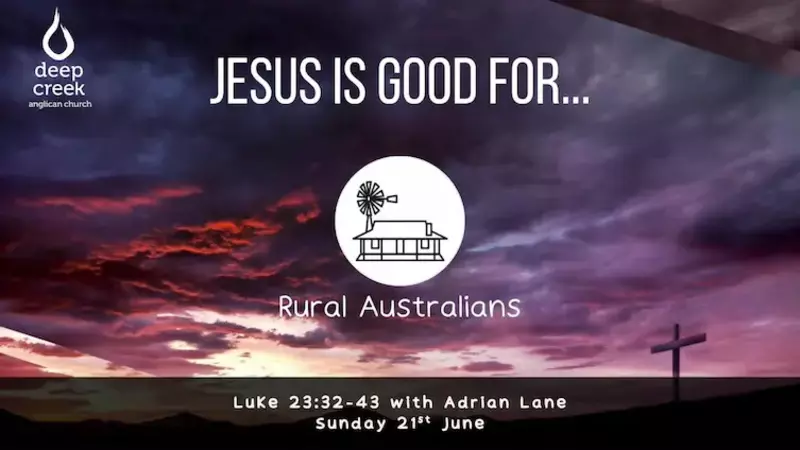
Luke 23:32-43
Good morning, a Bible reading this morning is from the Gospel of Luke, chapter 23, verses 32 through to 43.
Two other men, both criminals, were also led out with him to be executed. When they came to the place called the Skull, they crucified him there, along with the criminals. One on his right, the other on his left.
Jesus said, Father, forgive them, for they do not know what they are doing. And they divided up his clothes by casting lots.
The people stood watching, and the rulers even sneered at him. They said, he saved others, let him save himself if he is God's Messiah, the Chosen One. The soldiers also came up and mocked him. They offered him wine, vinegar and said, if you are the King of the Jews, save yourself. There was a written notice above him which read, this is the King of the Jews.
One of the criminals who hung there hurled insults at him, aren't you the Messiah? Save yourself and us. But the other criminal rebuked him. Don't you fear God, he said, since you are under the same sentence. We are punished justly, for we are getting what our deeds deserve. But this man has done nothing wrong.
Then he said, Jesus, remember me when you come into your kingdom. Jesus answered him, truly I tell you, today you will be with me in paradise.
This is the word of the Lord.
Forgiveness in a Self-Centred World
Thanks Glenn. Well you may want to keep, if you've got a Bible handy there, Luke 23 open and handy. It's the one time in church when you can look at your phone, but make sure it is only the Bible on the phone. Let's pray.
Dear Heavenly Father, we thank you so much that you speak to us through your word, the scriptures and we pray that you would soften our hearts and open our minds to understand what you're saying to us today, both as individuals and as a congregation, and move our wills to respond in a way that pleases you. And we ask this in Jesus' name, amen.
Well today I'd like to look at one of the amazing life-changing consequences of the Easter events that we celebrated a month or two ago, and that is forgiveness. It's not a word we often hear in our self-centered, blaming society, is it? I know that I find it very hard to say, please forgive me, especially to those who are close to me. In fact, the closer they are to me, the harder it is for me to say, please forgive me. You get into kind of ruts in your relationships, don't you?
But I find it even harder to forgive those who have plainly wronged me. And the wrong that they've done against me eats away at me.
You know, there's a bloke who owes me $600. It eats away at me. It embitters me. As I rehearse that wrong over and over again in my mind and speak about it all too often with other people.
Now I'm not sure that others always understand how they've hurt me, but nonetheless, I keep a little list in my mind to bring up later in an argument.
Well, in our passage today, we see three strikingly different people. And from each of them, we learn so much about this crucial issue of forgiveness. It's a very powerful passage. It's a story that most of us are pretty familiar with. We've seen pictures of it and sometimes it can overwhelm us as we better understand it. It comes at the climax of Luke's gospel, which is the good news history of Jesus.
Jesus's Extraordinary Prayer
Jesus has been training his disciples for three years, crowds have followed them. Jesus has taught, healed, exercised demons, worked miracles, and all that's to show the nature of his identity, particularly to the disciples. But the Jewish leaders haven't understood. In fact, they haven't even wanted to understand. And ultimately, on false charges, in a terrible travesty of justice, Jesus is executed with two other men, both criminals.
The first thing I'd like us to notice is Jesus's extraordinary prayer for those who are executing him. Even as they're driving the nails into his wrists, even as they're lifting him on the cross where he'll ultimately die of suffocation, he's praying for their forgiveness. Father, forgive them because they don't know what they're doing. That's verse 34. Now, this is unimaginable selflessness, isn't it? And it's worth us pondering again and again.
But despite such magnanimity, despite such graciousness, such generosity, indeed, plainly in the face of it, some of the leaders are sneering at him. He saved others, let him save himself. If he really is God's Messiah, the chosen one, verse 35 there.
If only they knew. If only they had a teachable heart and wanted to know. The soldiers also mocked him, didn't they, as they divided up his few remaining possessions for themselves, a few clothes.
It's an action, incidentally, that was prophesied by one of Jesus' ancestors, King David, in Psalm 22. It's like stealing from a homeless man. If you're a king of the Jews, save yourself, the soldiers say. If only they knew.
Pilate, the Roman governor, had had this notice made that he put above Jesus' head that also mocked Jesus by saying, this is the king of the Jews. He'd show them who's king, look at this king, he's on a cross, there's only one king, Caesar. If only he knew.
And what does Jesus do? He prays for them, not in a spiteful, vengeful prayer. Father, bring down your judgment upon them. That's the sort of prayer I pray, but a prayer that's full of compassion.
Father forgive them because they don't know what they're doing.
The Two Criminals: A Tale of Two Hearts
Let's step back a little from the scene. We've seen how Jesus is responding.
And we see that one of the criminals who is hanging there beside Jesus is also hurling insults at him. Aren't you the Messiah? Save yourself and us, get on with it. Verse 39 there.
He's obviously an angry man, isn't he? He's a shouter, a man who quickly loses his temper and doesn't stop to think.
And we've all come across people like him, especially since the pandemic on the roads, for instance, in queues at the shops and stuff. They shout and they bully us. They blame others for their troubles.
And then they expect other people to clean up the mess they made. And their anger leaves a stain on us, if we're honest, doesn't it? It bruises us and wounds us. It can sometimes leave a scar.
If only this criminal knew.
But on the other side of Jesus, there was another man wasn't there.
And this man realized that this world and its authorities were not all that there is. He realized that this world's really a foretaste, a precursor of a much more substantial world to come. And that life actually didn't revolve around us.
Don't you fear God? He said to the other criminal, we're being punished justly because we're getting what our deeds deserve.
But this man, with a nod to Jesus, has done nothing wrong. This man has done nothing wrong.
We've actually got a lot to learn from this criminal. He well knows that there's a God. He well knows that wrong needs to be punished and atoned for, paid for.
You can't just pretend wrong hasn't happened and just say, oh, sorry, I didn't mean to smash your car. You actually have to deal with wrong when it's happened.
The second criminal knows that he and the other criminal are being punished justly. He's not making excuses for himself. He's not blaming anybody else.
And he knows that Jesus is innocent. This criminal's been around. He knows a criminal when he sees him, and he knows that Jesus is no criminal.
The Gift of Forgiveness
Some of us are very aware of our need for forgiveness, aren't we? We know we've done the wrong thing, both by God and by other people. And many of us carry a burden.
We might carry it for years about things that we've done in our past. And we're a bit like that prodigal son who comes to his senses in Luke 15 in the parable that Jesus tells a few chapters before.
But others of us can't see that we need forgiveness. We blame other people, and we're self righteous, like the older brother in that parable. And you know what? God loves us both.
He loves those who are very aware of their sin, and he loves those who don't think they've really sinned much at all. Thanks very much. I'm as good as the next bloke.
And God's longing to forgive both types of people.
Ironically, this second criminal was a very fortunate man. You know, he could have been crucified in the last batch, or in the next batch. But he was crucified with Jesus.
He was crucified with Christ, to pick up the language of Galatians 2.20. And he'd been with Jesus on that walk to the cross. He'd heard Jesus praying for his executioners.
And he'd come to know that Jesus was like no other man. And by God's grace, he'd come to know something about who Jesus was, something about his identity, that he really was the Messiah, the Chosen One.
And this criminal comes to put his trust in Jesus in the very last moments of his life. Jesus, remember me when you come into your kingdom, he says to Jesus, in verse 43.
And Jesus responds with these wonderful, famous words. Truly I tell you, today you will be with me in paradise. Isn't that magnificent?
Truly I tell you, today you will be with me in paradise. This criminal is forgiven. And he's incorporated into Christ's kingdom. Not through anything he's done.
He hasn't had time to do anything. But through Christ's work, right there for him, beside him on the cross.
Living in the Light of Forgiveness
Because when Jesus died, he paid the penalty for sin and all the wrong that we've done. Which penalty is death? But he didn't pay the penalty for his own sin.
No, no, the criminal's already told us this man's done nothing wrong. And what's more, just a few hours later, the centurion, that tough bloke who's been leading the execution squad.
After seeing everything that's happened, he comes to Jesus and he says, surely this was a righteous man, in verse 47. He ends up praising God himself.
So Jesus doesn't pay the penalty for his own wrong. But he still does pay the penalty of death. And he pays that penalty of death so that we don't have to pay it.
That penalty's for you and for me. For the criminal and for the centurion. And indeed for all who cry out to Jesus, Jesus remember me when you come into your kingdom.
That's why Jesus had to die. That's why Jesus didn't save himself. He could have saved himself. He brought other people back to life, such as Lazarus and Jairus' daughter and the widow of Nain's son.
No, no, Jesus gave himself up to death so that the penalty for wrong would be paid through his death. The sacrificial death of an innocent person.
That second criminal died knowing he was forgiven. Looking forward with certainty to seeing Christ come into his kingdom.
Now we don't even know his name. But we know we too will meet him in paradise if we also put our trust in Jesus.
You know, when Jesus rose from the dead a few days later with a new body, he proved that that penalty for sin, which is death, had been paid, didn't he? Fully. Death couldn't hold him.
He has indeed saved others, but only at an unknowable cost to himself. As the soldiers have ironically taunted him, he has indeed saved others.
And he is indeed the Messiah, the Chosen One, as some of the leaders have tauntingly said. And he is indeed king of the Jews, and not just king of the Jews, but king of all kings, king of all emperors and governors, king of all people, as Pilate's notice said.
And who but the Messiah, the Chosen One, would dare to promise to another person in such terrible circumstances, today you'll be with me in paradise. And then rise from the dead with plenty of witnesses to prove that the penalty of death for sin had indeed been paid.
You know, forgiveness is not a word we often hear. And my own experience has been, I was a social worker before I was a clergyman, is that many people are labouring under the guilt of sin. They may not speak about it, but they carry it. It's a burden they carry. And in fact, in lots of the places where BCA is, there's a lot of people running away. In little opal-mining towns like Coober Pedy or Lightning Ridge, a lot of people running away from things that have happened in their lives.
This message of forgiveness through what Jesus has done on the cross, it's been transformational for me. It's been life-changing for me, to know that I'm forgiven, to know that when I die, I too will be with Christ in paradise, to know that there's absolutely nothing I can do, nothing in my hand I bring, simply to the cross I cling. It's great news, isn't it? And that's why I'm so committed to Bush Church Aid, because I long for everybody in every nook and cranny in Australia to hear that news and be relieved of their burdens.
Because it's not just great news for the future. Because as I understand Christ's love for me on that cross, despite my unworthiness, I can begin with God's help to have patience and love for other people. If God's loved me like this, then I should love other people who know not what they do to me. And I can begin with God's help, just begin again, as I say, if I'm honest with myself, to know how I actually might be hurting other people, even though I can't imagine it. But actually, with the Spirit's help, I can begin to understand how I might be hurting others.
We were reminded earlier in the children's talk about repentance. And when that first crowd at Pentecost heard what Peter had said, and he learnt that they'd actually crucified the Lord and the Messiah, they were cut to the heart and they asked Peter, what should we do?
Repent. Turn back, he said. Change. And be baptised, every one of you, in the name of Jesus Christ, for the forgiveness of your sins. And you too will receive the gift of the Holy Spirit.
Well, that wonderful promise is for us as well, isn't it? May we today know Christ's love and his forgiveness. And may God equip us by his Spirit to share that in a gracious and generous way with others. Shall we pray?
Heavenly Father, this message is almost too wonderful to bear, too amazing to understand. Give us an understanding of what it means for you to die for us. Give us an understanding of what it means to be forgiven, to have the slate wiped clean. And help us, Lord, to know how to share that with others, so they too can find the forgiveness that we've found through Christ's work and through his love for us. In Jesus' name.