Read the transcript
Psalm 24:1-6
Good morning, Church. We've got two readings today. The first one's from Psalm 24, verses 1 to 6.
The earth is the Lord's and everything in it, the world and all who live in it. For he founded it on the seas and established it on the waters.
Who may ascend the mountain of the Lord, who may stand in his holy place, the one who has clean hands and a pure heart, who does not trust in an idol or swear by a false god?
They will receive blessing from the Lord and vindication from God their Savior. Such is the generation of those who seek him, who seek your face, God of Jacob.
Colossians 1:15-20
The second reading is from Colossians, chapter 1, verses 15 to 20, which is on page 1829 in your Bibles.
The Son is the image of the invisible God, the firstborn over all creation, for in him all things were created, things in heaven and on earth, visible and invisible, whether thrones or powers or rulers or authorities.
All things have been created through him and for him. He is before all things, and in him all things hold together, and he is the head of the body, the church. He is the beginning and the firstborn from among the dead, so that in everything he may have the supremacy.
For God was pleased to have all his fullness dwell in him and through him to reconcile to himself all things, whether things on earth or things in heaven, by making peace through his blood shed on the cross. This is the word of the Lord.
Video: Building Climate Resilience in Kenya
Thank you. We're going to begin by taking you to Kenya and sharing some of our work there, which is great framing for our discussion today.
[The following short film by Anglican Overseas Aid (Anglicord) was played during the service.]
[Text displayed on screen]
A few years ago, Kenya experienced its worst drought in 40 years. Many predict this will happen again.
There is a climate change. Things have already changed. I have never come up a prolonged drought like the one we had last year. We have to do what we have never planned to do as Maasai.
Throughout this devastating experience, Anglican Overseas Aid's long-term partner, the Anglican Church in Mount Kenya West, was there. The churches, embedded in their local community, messengers for good who are in deep relationship with the people they serve. As they provided emergency relief, they recognised something more was needed.
For generations, the Maasai lived as pastoralists, moving with their cattle rather than growing food. Now, more frequent droughts are making this lifestyle impossible. With the help of AOA and our generous supporters, the church is rebuilding communities, helping them adapt and build resilience, preparing them for potential disasters in the future.
We are preparing communities one, by passing the relevant information so that they can know that climate change is here to stay. We have been trying to build the capacity of the community through trainings. So what we are doing is to integrate climate change in every aspect of our programming. We are also telling them to start training themselves to use minimum amount of water for growing of crops, and then these crops need to be high potential crops that can be able to give them a lot of income. We are also telling even children in school, so they will also be more responsible in taking care of the environment for tomorrow's generation. And when we carry the vision, AOA comes and supports us to actualise that vision. So that relationship, it's a partnership that is geared towards empowering our communities and making our communities more resilient, and ensuring that there is justice.
[Community member, translated]
Because of climate change, you have to organise yourself very well.
I have joined a women's group where we save money together.
Throughthat group i've been able to buy this rain collection tank so even if the river runs dry again, I will have something to drink.
If I had not stored water I would not be able to farm the way I am farming.
I am very proud because I am among a people who are trying to make the environment better.
Through this work, people are moving from survival to flourishing. Positive change is happening because Anglican Overseas Aid and Australian Anglicans have been consistently responding to the need, praying and giving generously. Communities are adapting and climate resilience is growing.
As a leader, I see a great change. We have to have a small kitchen gardens to sustain the families. As I harvest for today, I also prepare for tomorrow.
There is no quick fix for climate change or for its impact on real people. But we move forward with courage, standing alongside communities in Kenya, across Africa, and throughout the Asia-Pacific. Together, we can build a future marked by resilience and real transformation. A future moving toward God's renewed creation, free of poverty. Will you join us?
From Kenya to Melbourne: A Tale of Two Realities
Well, thank you so much for having me. It's a beautiful film, isn't it?
Every time I see that Maasai community and particularly Felicita, this lady that you can see on the screen, it really affects me. I was able to visit that community in the height of the drought and spend time particularly with Felicita.
As two mums talking and sharing, obviously with the help of the interpreter, it was very clear that the challenges and the realities we face are just so entirely different. She was watching her crops fail and she was trying to feed her children with one cup of emergency porridge that we were able to help provide.
Yet she was still showing up and she was serving her community and together they were gathering food and trying to find water.
And then I got on a plane and I came back to Melbourne and my comfortable life. And that whiplash is real and the stories that you carry with you are both a privilege and a responsibility. And something that has led to me writing the book and some of the stories that it's my privilege to share with you today because over a number of decades of working alongside people experiencing extreme poverty and also injustice and also the breakdown of the natural world, it is their stories that can help shape our responses. Stories we need to hear, they're not always easy to hear but ones that are a privilege to share.
God's Big Story: A Call to Care
Well today, firstly we're going to dive into the Bible and God's invitation to join in his big story. And that's something I'll cover in four brief parts. We're going to then move to glimpse the global church in action in diverse communities, in some of the hardest of places because together we can then start to see what is possible when God's people work together to care for his creation and of course care for each other as neighbours. And third, we're going to then look at what does it look like to be called to care for each one of us as followers of Jesus. What does it look like perhaps for us as the church as a whole?
Before I guess I go any further, I'd like to name attention because we are one church, we are one global family but actually we're experiencing very different realities. Like Felicita in Kenya and other friends and colleagues in the Pacific or Southeast Asia, our brothers and sisters on the front lines, they're on the front lines of an environmental crisis that they did not create. Yet if we're honest with ourselves here in Australia it can be easy to look away. This is not out of malice or ill intent but simply it's easy to do, it's comfortable. It's more comfortable not to notice.
Jesus spoke about the least of these in Matthew 25 when he was describing the sheep and the goats and our role in caring for those who were hungry, those who were thirsty, those who are a stranger. Well what if in our time the least of these are those who are on those front lines, who are hungry and thirsty because of the breakdown in the natural world? What if it is directly connected to a crisis that we have the power to be part of the change, to be part of good, to do something?
My invitation today is simple. It is what if we took God's call to care? What if we took that seriously? A call to care for people but also a call to care for our planet. What if we were to listen to and learn from our global brothers and sisters around the world?
Well let's begin with God's big story, that biblical call to care. And to help us unpack that I'm going to refer to a framework developed by a good friend and theologian, Dr Ruth Valerio, and she can help us see God's larger narrative running through scriptures.
So firstly, God created our world and he loves it. He called his creation good, beautiful. We have the power to be part of the change.
Those powerful words in the psalm, the earth is the Lord's and everything in it. There is a sense of awe. God is great and beautiful and of course his creation reflects that.
It isn't just a backdrop for human activity. It reflects God's intention for all creatures to exist in relationship with one another and with their creator.
Second, we've been created in God's image. We're placed in this world to take care of what God has made. That is an incredible privilege. It's also a great responsibility to be entrusted with stewardship of the earth, God's good gardeners.
And third, this world has gone wrong because of us. That's pretty obvious as we see sin fracture our relationships with God, with one another, but also with the earth itself. This plays out when we see broken relationships, we see poverty, injustice and we see the breakdown in the natural world. But here's the hope, we get to collaborate with God in healing this brokenness.
And fourth, this part changes everything, that Jesus has come to renew all creation. This is a big gospel.
God's plan isn't just to rescue us from the earth. It is to reconcile the whole world to himself.
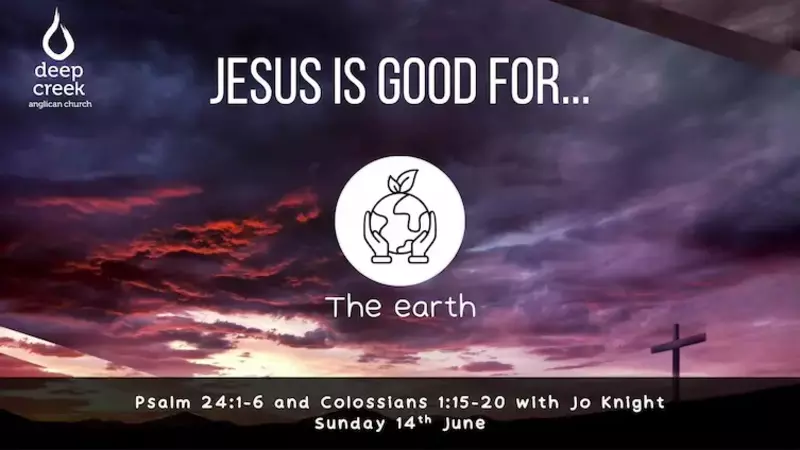
The title of this sermon and part of your series is Jesus is good for the earth. Those words in Colossians 1 that we heard earlier, let them sink in.
Through Jesus, God is reconciling all things, whether things on earth or things in heaven, by making peace through his blood shed on the cross.
The Son of God rules over the first creation. And because of this, he rules over the new creation.
Paul in Colossians is rejoicing that through Christ's perfect sacrifice, there is reconciliation and peace between people and God, between people together, but also people and creation.
This bit is so important because the Bible isn't just pointing to a world which is destroyed and where are us floating off to some other place. It evokes renewal. It evokes transformation.
The heavens and the earth will be made new. The good news is that God has a future for his world. And we are called to live in a way that looks forward to and anticipates that future.
God's mission is not limited to saving humanity alone. There's a ripple effect of cosmic healing. It begins in Christ's resurrected body. It extends to all those in Christ and ultimately encompasses the whole creation.
And that is good news.
Living Out Our Faith: The Church in Action
So what does this mean for us? Well, the implications are really very significant.
Firstly, what we believe about heaven is important. It matters. It then affects our actions.
So it's not just some vague disembodied existence. That's Greek and dualistic thinking infecting us when we think that way.
Think more of a physical renewed world that we are called to care for. As Jesus is good for the earth, so too are we called to care for his world.
Second, salvation means something bigger because we're not just saved to escape earth. We are saved to play a part in God's good purposes in our world right now. As the psalmist reminds us, this is a challenge and a calling for every generation to seek him.
And third, justice matters deeply. You'll see this running right through scriptures. It's about restoring right relationships and living in accordance with God's good intentions. The psalmist speaks of God looking for clean hands and a pure heart, of not worshipping what is false. And that is a call that echoes right through scripture and through the generations, and it lands squarely on us.
Well, as Christians, we are called to love our neighbour, and that includes our global neighbours. So let me share with you some stories of where I have seen the global church at its best.
So let's start with my friend, the Reverend James Bhagwan. He leads the Pacific Conference of Churches. Now, these communities are facing some of the most urgent crises of our time as they are encountering rising seas. They're encountering increasing and intense natural disasters. Their very existence is under threat.
And what's their response? Well, I would say it's the church being and doing exactly what the church is called to be as a faithful response. James describes it in a threefold way. He says their calling is to be prophetic, it is to be pastoral, and it is to be practical.
So one of the ways that they are prophetic is they speak truth to power. They show up at international forums, they're calling world leaders to act with justice for their blue Pacific home. I've seen this in action when I've lobbied at UN climate talks, and the Pacific church is such a significant presence, both as faithful Christians in their national delegations and as the church in its own right. They refuse to be silent when the most vulnerable in their communities are harmed by the breakdown of the natural world.
But not only are they prophetic, they are pastoral. They care very deeply for people whose lives and lands and waters are being devastated. They weep with those who weep. They show up. And from the prophetic to the pastoral to the practical, they're taking hands on action, they're building shelters, they're replanting mangroves, they're adapting their communities to help them survive and thrive.
This is where some of the work of my organisation comes in. So for example, in the Solomon Islands, we as Anglican Overseas Aid have been collaborating with churches to upgrade their buildings to serve as disaster shelters. So it's incredibly meaningful where churches can be redesigned to pre-position supplies, to be accessible for people with disabilities, and be that place when disaster strikes that the community can turn, ready for use. It's part of a larger effort that AOA and all the church-based agencies, the Uniting and the Catholics and everyone working really well together, both as Australian agencies and internationally, to help the Pacific churches be ready for more natural disasters, disaster preparation work. One of this looks like communities mapping their strengths and vulnerabilities and training up volunteers village to village so they know what to do, they have a plan for when disaster strikes.
Now this isn't just environmental work or development work. This is the gospel. This is an embodied gospel that is holistic and alive, word and deed inseparable, and the church responding with everything that it has. When I see the Pacific Church in action, I'm reminded of what we're all capable of, and Hebrews 10:24 reminds us, let us consider how we may spur one another on towards love and good deeds. This is a team sport and our response isn't just about our individual actions, although they matter. It's also about how we as a community inspire and challenge one another.
And here's the beautiful thing, that when we respond like this, when we let God's spirit disrupt our complacency, we don't just change the world. We grow as disciples. We become more fully who God intended us to be.
Our brothers and sisters in the Pacific know that they are called to a specific time and place. They are placed and part of a specific culture. And in God's wisdom, that is good for them, that is good for their communities, and it is good for God's world.
And it's something that I think that the Pacific Church is teaching us, and something that we at times can lose in our context.
Facing Our Complicity: A Call to Repentance
If that is a glimpse of the church at its best, I think it's important to recognize that we're not always at our best.
We're in an environmental crisis in our world because of human activity, especially over the last 200 or so years. The Industrial Revolution brought many benefits, including lifting many out of poverty, but it also locked in our reliance on non-renewable sources and fossil fuels.
And the Earth's systems, those systems designed in God's wisdom, they simply can't cope. They can't cope with the extra heat. We're already seeing those impacts.
We're seeing temperatures rise, rainfall damaging homes, intense heat waves, yet also droughts that lead to water shortages.
Now, scientists call climate change a threat multiplier. They take existing issues like poverty or inequality, gender injustice, conflict, and make them much, much worse.
I saw that firsthand in those communities in Kenya. Underlying issues, development gains unraveled, everything intensified, a threat multiplier firsthand.
We live as global citizens that prioritize relentless growth over everything else. Our cultures of consumerism distort God's intentions. They distort what matters and the harm that we can do to others.
And we've reached the point of environmental limits. These are God-given limits, and we're starting to see the consequences.
A hard truth is that the church in the wealthy Western context like ours has often been complicit. Sometimes that is a sin of omission. We simply look away.
But sometimes it's a sin of commission. We let political polarization cloud our discipleship, or we pursue private salvation and give these priorities and these problems very low priority.
I think that's a sobering thought because suffering experienced by people around the world does affect us all, and it affects our father's heart.
The breakdown of the natural world, it affects the earth. It's our common home, and so we cannot observe it indifferently.
Don't mishear me because I love the church and we are family, and this is my life's calling. So it is out of that love that I make this call, that I want us as part of the church to be part of God's good purposes. I want us to live up to what we are called to be and the role we can play together.
Called to Care: Our Role in God's Kingdom
So where does this leave us? Well, I think we need to talk about calling because I think that's where the shift can really happen. My own aha moment, as I touched on earlier, really started to come together as I was bringing together my advocacy and walking alongside people on issues of poverty and injustice, and started to really make that connection with the dependence and the breakdown on the natural world and the harm that that was causing. And that conviction around the harm of something like climate change on the world's most poor, most vulnerable, that has shaped my calling. It's led me to write the book, Called to Care, but also to lead Anglican Overseas Aid.
But calling looks very different for each of us. For Felicita in her Maasai community, it's climate resilient farming and it's activating her community. For Reverend James in the Pacific, it's about speaking prophetically and caring pastorally. And for someone here today, it might look like advocacy, it might look like education, or simply paying closer attention to your everyday choices and how they ripple outwards and could be a source of goodness rather than harm.
It also doesn't need to be a total life change. It might start with a stirring, a nudge, something that you've noticed that won't let you go. And that is worth paying attention to. Try and listen for God's voice in those spaces. God places different things on different hearts.
And here's what gives me hope. We are more powerful than we think.
I want you to cast your mind back to movements of social change, times where change seemed impossible. I've just been in London for work and I was at the museum looking at the history of the East India Company and colonization, but then the abolitionist movement.
And the abolition of the slavery that seemed so unimaginable. It was so tied up in their economic systems. It took time and many people working in different ways to start to see that change could be possible.
Also last week I saw a bit of the history of the suffragette movement and was reminded of the power of women getting the vote in this country only a few generations ago. Perhaps it's the civil rights movement or the abolition of apartheid.
In my own experience with Micah Australia, the coalition of the Christian aid organizations, we've been able to see what happens when churches work together. So during the COVID pandemic, we came together, we showed up and we had a campaign called End COVID For All. And against all the odds, we can trace and see how an extra $1 billion was given in emergency pandemic aid to our nearest neighbors because we in the Australian church spoke up and we were able to help the communities around the world that needed help the most.
So my point is that change is not only possible, but it's God's desire for us to participate in his kingdom, that his kingdom may come on earth. Each of us does have a sphere of influence. So when we respond to God in obedience, that ripples outwards. We may not always even be aware of all the ways that God is at work, but it has that ripple effect in our families, in our homes, our workplaces, and in our care for creation around us and ultimately to our brothers and sisters around the world.
So purposeful living isn't just about big change for the world, though that also matters. It's also about the day to day. It's about the faithfulness in practical steps.
It might be the conversation you're having over coffee. It might be your choices or your restraint at the checkout. It might be the prayers you're praying on the bus.
Because the truth we need to sit with is about the interconnectedness of our actions. Our actions here do impact people around the world.
The way we live in Australia is connected to the way that our neighbours are experiencing life, to the groans of our earth, and that all matters to God.
So let me come back to that question from the start of what if we took our call to care for both people and our planet seriously? What if we listened to and we learnt from our global brothers and sisters? Well, I believe that we in the church in the West will become more alive. We will be more drawn into God's heart for His world, and it will make a real difference in the lives of people like Felicita and the environment that her community depends on. And after all, we are all part of creation and we depend on our common home, the earth that God has created.
So here's a few ways that you can respond today. Please pray with us.
Anglican Overseas Aid is always putting up updates and prayer points to do with our partners around the world. This is our global church family, the Anglican Church at work around the world.
So please stay connected and find out more ways that you can be part of understanding and supporting what the global family is doing.
And right here in your congregation is Lyndal, who's on our board, and she can always share extra things that are going on behind the scenes, because we'd love to keep you in the loop.
We really see this as an expression of our church.
Please also consider going deeper. So I encourage you to pick up a copy of the book, look at some of the extra resources we've created, like the Bible study videos, companion journals, other ways to help you process what you might be engaging with, but turn that into a plan. How does that turn into practical steps that you could do as a response? Because for all the stories and the ideas, it's when you land it in a practical plan that you'll be able to take that next best step. So please talk to me later about that.
Because as we reflect further on God's calling on each of our lives, may we remember that phrase from the Psalms, that the earth is the Lord's and everything in it. Let me close with a benediction. You are called to care. May that calling shape your prayers, your choices, and your love for the world that God has made. Amen.