Read the transcript
Exodus 25:1-22
Good morning. There are two readings this morning. The first is from Exodus chapter 25 and can be found on page 124 of the NIV Bibles if you're following there.
Exodus 25, Offerings for the Tabernacle.
The Lord said to Moses, tell the Israelites to bring me an offering. You are to receive the offering for me from everyone whose heart prompts them to give. These are the offerings you are to receive for them.
Gold, silver and bronze, blue, purple and scarlet yarn and fine linen, goat hair, ramskins dyed red and another type of durable leather.
Acacia wood, olive oil for the light, spices for the anointing oil and for the fragrant incense and onyx stones and other gems to be mounted on the ephod and breast piece. Then have them make a sanctuary for me and I will dwell among them. Make this tabernacle and all its furnishings exactly like the pattern I will show you.
The Ark Have them make an ark of acacia wood, two and a half cubits long, a cubit and a half wide and a cubit and a half high. Overlay it with pure gold both inside and out and make a gold moulding around it.
Cast four gold rings for it and fasten them to its four feet with two rings on one side and two rings on the other. Then make poles of acacia wood and overlay them with gold. Insert the poles into the rings on the sides of the ark to carry it.
The poles are to remain in the rings of this ark, they are not to be removed. Then put in the tablets of the covenant law which I will give you.
Make an atonement cover of pure gold, two and a half cubits long and a cubit and a half wide. And make two cherubim out of hammered gold at the ends of the cover. Make one cherub on one end and the second cherub on the other.
Make the cherubim of one piece with the cover at the two ends. The cherubim are to have their wings spread upward overshadowing the cover with them.
The cherubim are to face each other looking toward the cover. Place the cover on top of the ark and put in the ark the tablets of the covenant law that I will give you. There above the cover between the two cherubim that are over the ark of the covenant law, I will meet with you and give you all my commands for the Israelites.
Ephesians 2:14-22
Second reading is from Ephesians chapter 2 verses 14 to 22 and can be found on page 1816. Beginning at verse 14.
For he himself is our peace who has made the two groups one and has destroyed the barrier, the dividing wall of hostility by setting aside in his flesh the law with its commands and regulations.
His purpose was to create in himself one new humanity out of the two thus making peace and in one body to reconcile both of them to God through the cross by which he put to death their hostility.
He came and preached peace to you who were far away and peace to those who were near. For through him we both have access to the Father by one spirit.
Consequently you are no longer foreigners and strangers but fellow citizens with God's people and also members of his household built on the foundation of the apostles and prophets with Christ Jesus himself as the chief cornerstone.
In him the whole building is joined together and rises to become a holy temple in the Lord and in him you too are being built together to become a dwelling in which God lives by his spirit.
This is the word of the Lord.
The Part of Exodus We Often Miss
More that comes after the ad break but I simply didn't know that there was anything more to hear and I think I've been brought up the same way with the book of Exodus. It's been a staple part of children's ministry and youth ministry. You hear about God's people groaning in slavery.
God raises up Moses and Aaron to come and confront Pharaoh. They confront Pharaoh. Pharaoh hardens his heart.
God raises up ten plagues until Pharaoh finally relents. Pharaoh lets them go.
The people make their way to the Red Sea. Pharaoh changes his mind and chases off after them. It's all very dramatic.
It's the thing of many Hollywood movies but God splits the sea. God's people race through and the sea closes in over the Egyptians and as far as I knew the people move into their mansion in the promised land and they all live happily ever after.
Okay, so occasionally we'd get a little bit of Sunday School material on the Ten Commandments which comes somewhere in the rest of Exodus and there'd be a sermon every now and then on a golden calf which comes somewhere in the rest of Exodus but as far as I knew it was like the sound of music. This is where the story finishes and I didn't even realize that there was more to the book of Exodus that I didn't know I wasn't getting. Now, my parents have done a number of things right as well and one of those is to try and instill a degree of history in the family.
My brother is the one who teaches history. I still don't quite understand how it works but they took us on a modest family holiday to Europe and it did feel like we were just going from one palace to the next to the next to the next and I wish I'd known when I was on this family holiday that going from one palace to the next to the next to the next actually helps us to read the Bible.
It actually helps us to read the rest of the book of Exodus and it's okay if you're sitting there not quite sure how this connection works. It's not an obvious connection that a preacher might draw. I had that same sensation.
I was living around the corner from here a quarter of a century ago and it was Easter and I went to the local upmarket Anglican church on Good Friday and I'm looking at all these visitors, those nice upper middle class people who come to darken the door of a church just on once a year on Friday and the Bible reading was the first of our readings from today. Exodus chapter 25.
And I sat there going, what on earth is this preacher thinking? And you might have had that same reaction this morning. We are going to spend our time in Exodus 25 of those two readings if you'd like to turn it up.
What on earth is a sermon doing about the Ark of the Covenant? Isn't it just some old dusty artifact?
Isn't it part of an old religious system that Christians celebrate abandoning? Those of you with a high church background go, we're moving back towards special furniture again and those of us who are low church going, we don't believe in special furniture. So what on earth is Exodus 25 doing?
And the answer is, it's one of those really, really valuable chapters that we need to have if we want to understand the story of the Old Testament and if we want to understand Jesus. Now you might have your favourite verse.
You might be one of those people who's memorised John 3.16. You might have your favourite chapter. I went to a group when I was young and they memorised one or two different chapters out of the Bible.
Some people think you might need to have John chapter 1 or you might need to have Colossians chapter 1. If you've ever been to a church with Drew Melloris, a vicar, you have to have Ephesians chapter 2.
You know what I'm talking about. And there are nearly 1,200 chapters in the Bible and I think Exodus 25 needs to be in your top 20 chapters, perhaps in your top 10 chapters. It's a big call and I have 23 minutes left to try and convince you.
This week and next week we're looking at some of the more neglected parts of the book of Exodus. You might have those people in your family who've suddenly gone a little bit family tree crazy and they regale you with lovely stories of six or seven or eight generations of uncles and cousins that you didn't know you had and didn't know you needed.
But you get these conversations at Easter or at Christmas and you discover a little bit about where you've come from and what it is that's brought you to where you are today and perhaps the values and character systems that make you make choices for the future. Well, that's what the Old Testament is for us. It's the family origin story of Christians about where we've come from, where we are today and the sorts of character and decision-making values that we might use into the future.
And today's chapter is the beginning of 16 chapters in Exodus. You may not have known you were missing.
Here's all 40 chapters of the book. We're very familiar with the first part because we tend to do that with our kids and our youth, God's rescue of the Israelites from Pharaoh and the other Egyptians. We might spend a little bit of time in the middle chunk where we talk about God's giving of the commandments.
We might do the Ten Commandments. We're not so good at memorizing the other 603 of them.
We'll come back to look at some of those next week. We're not very good with the last 45% of the book because, like my experience of The Sound of Music, maybe you've had an ad break and gone to bed before the end of the movie. Exodus shows the Israelites rescued out of slavery in Egypt, shows them being formed as God's special possession, his collector's item.
And then from chapter 25 on, we read about the building of God's throne room. And we've heard only one half of chapter 25 today, which is the beginning not just of God's throne, but of God's throne room, and not just of God's throne room, but of his whole palace.
Building God's Palace
So if you have your Bibles open, you'll notice that we've got a number of different sections in the NIV. They're sectioned off with headings. And the key points for this morning come from the end of those first two sections.
So the chapter begins with a collection of a whole bunch of building materials. We hear of all kinds of precious metals and wools and fabrics and leathers and woods and oils and valuable gems.
And it's the lucky week to be Margaret and on Bible reading. And we're told twice in verse 2 that these are offerings that the people bring for God's service. And we hear as these chapters roll on that the people are actually obedient.
They do bring all of these building materials. And in fact, like very few churches that I visit, the people are so enthusiastic about this building program that eventually the leadership has to stand up and says, stop, we have enough.
And as we read through that list, and if we do any bit of study into ancient building materials, we start to realize that these are gifts of value. These are offerings that are fit for a king. And as we start making our way through the blueprints in these next 16 chapters, and then we watch the building of the tabernacle through these chapters, the Israelites are building a palace for God.
Now, we might not automatically draw that connection. The Israelites are currently going through a portable stage of life.
They're moving from Egypt into the promised land of Canaan. And as they move, they're currently living in tents. And God says at this point where the people are camped at Mount Sinai, I'm coming with you, build me a tent to join you.
But it's a grand tent. It's a tent that's fit for a king.
And there's the summary at the end of the first section in verses 8 and 9.
Then have them make a sanctuary for me, and I will dwell among them.
Make this tabernacle and all its furnishings.
And all of a sudden, our ears go, this sounds really rather religious. Because we've heard these terms only at best in places like Exodus.
And they sound very religious, and they sound very formalized. But this is actually very everyday kind of language. So God says, build me a sanctuary.
That just means a God space, a God place. Some churches like to say the building, or the main building, or the real building is called the sanctuary, and maybe some other ancillary buildings.
But it just means a God place. And we very rarely hear the word tabernacle, but that's just because somebody got excited by some Latin. But tabernacle is the Latin word for tent.
So in real human common language, God says, have the Israelites make for me a God place, and I will dwell among them. Make this tent, this tent dwelling and its furnishings.
And if we've grown up with a diet only of the New Testament, we might be sitting there going, what's going on here? This is a weird kind of move from God. But already we should be starting to hear that this God, as he expresses himself in the Old Testament, is exactly what we hear and celebrate in the New Testament.
Here is not some God who is shy and retiring. Here is not some God who's hiding away and maybe at best tolerating humans coming to seek him out.
No, here is a God who's interested in hanging out with people. Here is a God who's chosen a crowd that he's going to start with, and he moves into their neighbourhood. He chooses his residence.
We celebrate with all our friends who've acquired houses in the last few months. You know who you are.
And it's great to have a stable place. God is currently going through real estate commons saying, these Israelites, this tent. Friends, here is the basis of the whole Old Testament religious system, which then helps us understand the New Testament religious system as well.
This is why Exodus is full of architectural blueprints and building designs. Here is why when we turn the pages, we make our way into Leviticus and hear about various sacrifices and ways to be considered clean and unclean.
That's about how you come to enter into God's presence. This is how you wipe your feet on the doormat before coming in. And then we turn the pages into Numbers and Deuteronomy and we hear about a special group of doorkeepers called the priests and also how God expects his people to behave when they knock on his door and come inside.
We find that the Israelites are not just ambassadors on behalf of God's people, but the Israelites are God's neighbours. The Israelites are attendants in God's household.
And if you make your way through to the end of Leviticus, you hear these really exciting statements.
If Israel follows God's commands, God says, I will put my dwelling place among you.
I will walk among you and be your God.
But we're starting to get ahead of ourselves. Come back next week and we'll hear a little bit more about how this building functions.
But today we're thinking just about the building itself, about how we build God's throne room, how we build God's palace, what that looks like and the fact that it's a tabernacle, a word that doesn't mean much to us. It's a tent that doesn't mean a whole lot to us, unless you're one of those people glamping and you might as well just take your whole four-bedroom house with you. But here is God's tent, and it's far grander than we might envisage.
It is a portable tent, but it's made of the finest materials. It's decorated in rich furnishings.
It's fit for a king. And God's presence, God's voluntary interest in being near his chosen people, is the key theme that starts off in the second section in today's reading. Yes, it's all about the Ark of the Covenant from verse 10 onwards.
The Ark as God's Throne
Yes, there's a whole bunch of detail here, as there are through the remaining 15 and a half chapters of Exodus. You might be one of those people who's tried to do a good Bible reading plan.
You've made your way through most of Genesis and only skipped a couple of genealogies here and there. You might have got into Exodus and enjoyed the nice drama. You might have waded through the terms and conditions for God's people that is the Book of the Covenant.
But you get to chapter 25, that's sort of okay. You get to chapter 26, it gets a bit more tedious.
Then all of a sudden, oh, that's okay, I'm behind anyway. It's time to jump to Leviticus. No, no, it's time to jump to Deuteronomy.
No, it's time to jump to Joshua. And we miss some of this detail.
It's here. You might find even these 10 verses. Look, this is great if you're an interior decorator.
You want to know what kind of materials or what kind of specifications. This might be good if you're working on an Indiana Jones movie.
But please don't miss the grandeur of what's going on here because this intricate detail tells us of something about God's throne. I'm really, really grateful for people who are good at reading the detail and turning things into a visual representation. And I'm happy to say the movie is actually a very good visual representation of what's going on.
But verses 21 and 22 tell us about the purpose for this ark. Again, we've got another technical word here.
We talk about the ark of the covenant. Ark is just a fancy word for box. This is the box of the covenant.
It's a very important box, and it's a very richly outfitted box. It's completely gold-plated, but it's a storage box.
And we're told what gets stored inside.
Verse 21, place the cover on top of the ark. So there's a lid on our box. And put in the ark the tablets of the covenant law that I give you.
So when you think of Charlton Heston and the two tablets of the Ten Commandments, that's what's stored inside this box.
But then here, what happens after that?
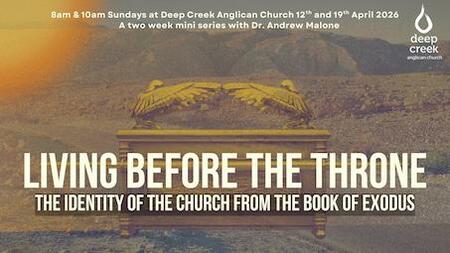
Verse 22, there, above the lid on the box, the cover of the ark of the covenant, between the two cherubim that we see in the picture, I will meet with you, and I will give you all my commandments for the Israelites.
This is God's throne. Other parts of the Old Testament use this language of God enthroned between the cherubim. Sometimes they paint an even grander picture of God who is enthroned in heaven and whose feet reach down, and this is his footstool on the earth.
And this is where you get to be a little bit cheeky and try and work out whether your Sunday school teachers have helped you or not helped you. We learn all these big words about God when we're going through upper primary and lower high school. We say that God is omnipotent, which means God can do anything.
We hear that, got to practice another Latin word, God is omniscient. That means that God knows everything.
And we say that God is omnipresent, and thanks to Colin Buchanan, who's taught it to our children and to us as we drive around in the car, omnipresent means that God is everywhere, guitar. And it's true that God is everywhere, but Exodus and other parts of the Bible show us that God also makes himself more present in certain places and at certain times. We read back in Genesis that God chose to walk with Adam and Eve, not just all minutes of every day everywhere, but in a particular garden at a particular time of day.
As we read through more of Genesis, we hear that God makes himself especially visible to have conversations with Abraham or with Jacob or with Moses. We celebrate Christmas and then at Easter how God has poured himself more fully into the human person of Jesus Christ.
And then we watch as God in the person of Jesus Christ dies and rises again. In six weeks' time, we'll celebrate Pentecost when the Holy Spirit is not just everywhere in general, but more specifically dwelling in Christians as they gather together. God can access everywhere.
God is everywhere, guitar. But he chooses to make himself more concentrated in some places and at some times.
And this Ark of the Covenant, this throne of God, is one such place and one such time. God says this gold-plated box will serve as his throne for the foreseeable future. And it's here that he wants to meet and communicate with humans.
This is a dramatic moment in biblical history and it's one which continues to teach us about our God and how he operates. The rest of Exodus will unfold for us, the process of building not just God's throne, but building his throne room, and not just building his throne room, but building the rest of the palace as well.
God's throne, the Ark, is found in the central inner room. That's at the very right-hand end of the picture. And then we'll hear about the layout of that room and then the layout of the adjoining room.
It's got a candlestick so you can tell when God's home, just like you know when the governor general is at home with the flag up on government house. Then we'll hear about the courtyard that fences around God's tent.
And again, we get a lot of detail about the instructions, about the building materials, about the walls, about the leather coverings that go over the top, about the fence, courtyard, and the other furniture. And again, as we read through the coming books, we'll hear about what are the rules for visiting this monarch in his tent. You don't just barge into a palace and knock on the queen's door or the king's door, whoever's at home.
And we'll hear next week a little bit more about God's visiting protocols. But what should we do with all of this?
A Pattern That Points to Christ
If you've been at church for any time, you're familiar with the idea that all Scripture is God-breathed, all Scripture is useful, all Scripture leads us to an understanding of salvation and Christian living. And if that's the question, then why have I not been exposed to these chapters as much as I should have? Why are some of you sitting there going, I'm sorry to say it, but this is slightly new material to me?
Or I did try and read through the whole Bible and I did skip the second half of Exodus. There's lots and lots and lots we could unpack here.
But let me give you a few of the edited highlights. Again, we're hearing about the tabernacle and the ark, about the leather tent and the gold-plated throne at the centre. And this is not the end of the story.
We're already told in verse 9 that this is representative of something more. Let me show you how I get there.
If you're familiar with architectural models, some of us like these more than others. You don't have to look very far. You can actually go and stand at the front door of the church here and see the number of towers going up in Templestowe.
Or you can look at the horizon in Doncaster and Box Hill. And if you go a little bit further to where I'm at church, Glen Waverley has a whole bunch of these sorts of towers going up.
And I could spend hours staring at these sorts of things. I was house hunting a couple of years ago and I walked in to look at the buildings going up in Glen Waverley and I'm sitting there going, ooh, that second top floor on the west corner, I could buy apartment 1708A. Now, if I bought 1708A, then I'd be able to see the station, I could see the CBD, I can look at the mountains, I can see almost east of Deep Creek.
But the aim of the exercise was not to buy a small piece of cardboard near the top of a model. This was a model that was showing me that something more was about to become real, something that I could invest in.
And that's what God does with the earthly tabernacle and, in fact, with a whole bunch of the Old Testament. The Old Testament is God's training wheels as you learn to ride a bike. The Old Testament is God's architectural model as you learn to think about how does God dwell among people?
How do you wipe your feet before you enter through God's door? What does it mean to function as God's door person on the way in?
And verse 9 tells us that this is what's going on.
So make the tabernacle and its furnishings exactly like the pattern or blueprint that I will show you.
Again, we see that at the end of the chapter, which we didn't read this morning, but verse 40, see that you make all of this according to the pattern or the blueprint shown you on the mountain.
And we know that we're on the right track here because if you get to the best book of the Bible, it turns out to be the letter to the Hebrews in the New Testament, that there is a real heaven with a real God sitting on a real throne. We access that God through his ultimate doorman, a real permanent priest, Jesus, a great high priest who ushers us into God's throne room.
He does that by offering a superior sacrifice that's so much better than a sheep or a goat. In fact, Jesus' work is so superior that it never needs to be offered again. But it's not just the letter to the Hebrews, one more part of the Bible that you need to go home and practice reading.
But the more familiar parts that many of us have heard celebrate this same kind of detail. The letters of Paul, the Gospel of John, talk about God put forward Jesus, and they use this very special word, and they basically say God put forward Jesus as an ark cover.
The ark cover is where the priest sprinkles the ultimate blood of the ultimate sacrifice so that you can enter into God's presence. Romans tells us, 1 John tells us that Jesus is the ark cover. And I'm not talking architecturally here, I'm not talking spatially here, but functionally, what we've just read here in Exodus 25, the ark cover is the special place where God meets with people and communicates with people.
God is using an architectural model through the Old Testament so that when Jesus lives and dies and rises again, we can hear that this is the special place where God meets with people and communicates with people. This is an architectural model that we might have missed in our life.
And so it makes sense and gives us incentive to start reading through these 16 chapters at the back of Exodus as we hear about the design and the careful construction of this portable palace, because we find out how God likes to live and how God likes to meet with people. If we read right through to the very end of Exodus, we find that we've designed the tabernacle, we've collected the materials, we've built the tabernacle, and finally the glory of God moves in. And God is so concentrated at this point.
He turns the dial up. Here's that youth member in your family who's got a guitar with an amplifier that goes, it does go to 11.
God turns the dial up to 11 and no Israelite can be in the tabernacle at that point. Not even Moses can be in the tabernacle at that point. God is far more clearly and concentratedly here on earth at this point in the biblical story.
And if we've got these chapters of Exodus, how much more will we understand of the New Testament? You might know the start of John 1 where we hear this word, the word became flesh and made his dwelling.
The language actually says God lived among us. God tented among us.
You'll find some translations of the Bible will be cheeky and say the word became flesh and tabernacled among us.
And that reminds us of the warnings, the instructions, the architectural model that God has given us all the way back in Exodus. Jesus is the epitome of what it means for God to dwell among his people.
He's the reality of which we're given a sneak peek in the scale model. And the New Testament tells us of yet more places in which God's glory dwells on the earth. I've already mentioned that some churches like to build a special building.
I remember the first building where I walked in and discovered there was a little plaque at the back, the piece of paper that says, this is sacred space, and gave the GPS blueprint details, the coordinates of this particular building, suggesting that God is somehow more at home in these four walls than outside. But we know that God has become specially concentrated among his people in Jesus.
Living as God's Dwelling Place
And now through God's Holy Spirit, when two or three of God's people are gathered together, there is God among them. You might have caught a glimpse of this in our Ephesians reading. Ephesians chapter 2 is another one of those chapters where we might better know the first half of the chapter than the second half of the chapter.
So it's true that when we gather together this morning, this building, these more than four walls, is a special place. And God is especially gathered here this morning.
But it's not because of these particular walls. It's not because somewhere there's a special piece of paper that says this is a sanctuary, this is a God place, but because you and I are gathered here today. And it means that when our kids do go out, that becomes a God place as well.
When our youth meet, that becomes a God place as well. When our growth groups meet throughout the week, that home that you gather in or the cafe that you gather in, the walking track you walk down, becomes a special God place with God especially concentrated there.
Not because of the architecture, but because we are now God's architecture. And so as we come before God this morning, already this building becomes the new version of the tabernacle. The tabernacle was replaced by a physical temple.
We are the new version of that temple. We are now the dwelling place of God, among whom God dwells by his spirit.
When we go through communion liturgy, you'll hear that language. The phrase, we are the body of Christ, and the response is, his spirit is with us. And you can say that in whatever building you're in.
You don't need a special building. God sees us as his new residents, and we hear that in these closing verses of Ephesians 2.
We are being built up together on the foundation of the apostles and the prophets, but being built on Christ Jesus himself as the chief cornerstone. And in him, the whole building is joined together and rises to become a holy temple to the Lord.
And I hope you heard the very last verse that Margaret read for us. And in him, Christ Jesus, you too are being built together to become a dwelling in which God dwells by his spirit.
And so we remain God's dwelling place here gathered on a Sunday morning and when we step outside.
If you meet together for lunch, you are still God's dwelling place. If you meet in a growth group through the week, if you have Christian family at home, the holy place, God's throne room, travels with you. Our Christian sisters and brothers in wider parts of God's world are God's people and he is among them, even if they're too poor to afford a special building, if they're not allowed to build a special building.
And it means that when we travel, we can gather with them too and we are part of God's holy place in other locations. And how then should we conduct ourselves if we are permanently the dwelling place of God?
How would you conduct yourself if you get to do one of those nice European tours where you get to go and hang out in some dignified palace? What would you do if you walk into a monarch's home? What would you do if you walk into a monarch's home and the monarch is there?
And at least half the New Testament authors pick up on this for us. As you can read earlier from 1 Peter and 1 Peter 1, continues to the language of,
be holy because I, the Lord your God, am holy.
And we'll see next week that Peter goes on to say, you are that holy dwelling place where God lives. We need to live in such a way that reflects God's presence among us. We need to reflect and honour that.
And it's not only about the things that we refrain from doing and saying, which might bring disrepute into God's presence, but when we think about a palace, we can think about all the rich adornments. We can think about all the positive steps we might take.
Think about the praises that we might lavish on the monarch who invites us to be part of the architecture of this building. And it's not just what we say. Don't misunderstand the song.
It's not just that all I have fit for a king is the words hallelujah, but it's the way that I then live out that hallelujah as well. If I'm not sure about my own value in God's sight, what does it mean that I am one of these bits of furniture? Now, there are small bits of furniture.
There are minorly functional bits of furniture. I'm pretty sure that I'm not a big and shiny one of those. Thank God if you are one of the big and shiny bits.
But you have a dignity because God builds you as part of the furniture in his dwelling place. And that person sitting down the other end of the pew that you're not quite sure is big and shiny either, they're still part of God's furniture as well.
We need to honour and respect the other members in God's church because God has chosen them too to be part of his residence. And so we read in Exodus that God is accustomed to dwelling in a palace, in a richly appointed palace. It's one of the reasons why we read through these details and find out just how much effort went into the physical temple that God builds for himself.
How much more for us. You'll notice if you read through the details in coming chapters that you start at the outside and things get richer and richer as you get closer to the central throne room.
You start with bronze on the outside, then silver, then a whole lot of gold. And again, how much more was that portable tabernacle repeated and amplified when God said, okay, the people have stopped moving around in tents. They're now living in stone buildings.
I'd like a stone building, please. So we build the temple.
And then how much more is that repeated and amplified in us when God says, I'm going worldwide portable. I'm now traveling with all my people everywhere. You are now part of that furniture, of that rich appointment, of that piece of furniture that can honor and revere the God who dwells among us.
Brothers and sisters, I offer you this morning part of the message of Exodus 25, which is part of 16 chapters you might not know very well. But here again is a God who's always sought to live among his people.
And he's kindly sought to illustrate that for us so that when we get to the New Testament, you might be an engineer like I have been, and you go, I don't understand words, but I understand pictures. Here's a picture that helps me know who I am. Here is an architectural model that shows me that God dwells and God has expectations of his dwelling.
And God now wanders wherever we wander to the ends of the earth. And God expects his dwelling place to be one of grandeur.
He expects it to be something that we give due glory to, sometimes in the physical buildings that we build, but much more in the physical lives that we live and the behavior and conduct that we show to the wider world. The Bible here, and you'll find time and again right through the New Testament, calls us to put in careful effort into adorning our behavior and our words that we might reflect well on the God who dwells among us. Let me commit us using a prayer from another letter of Paul's.
Paul writes for the church,
May the God of peace himself entirely sanctify us. That is, would he make us holy?
Would he make us a suitable residence for him to dwell in? And may our spirit and soul and body be kept sound and blameless until the coming of our Lord Jesus Christ, the one who calls us is faithful and he will do this.
Amen.