Read the transcript
Luke 19:1-10
Good morning, everybody. This morning's reading is from Luke's Gospel, Chapter 19, verses 1 to 10. It's a very well-known story of Zacchaeus, the tax collector.
Jesus entered Jericho and was passing through. A man was there by the name of Zacchaeus. He was a chief tax collector and was wealthy. He wanted to see who Jesus was, but because he was short, he could not see over the crowd. So he ran ahead and climbed a sycamore fig tree to see him, since Jesus was coming that way.
When Jesus reached the spot, he looked up and said to him, Zacchaeus, come down immediately. I must stay at your house today. So he came down at once and welcomed him gladly.
All the people saw this and began to mutter, he's gone to be at the house of the sinner. But Zacchaeus stood up and said to the Lord, look, Lord, here and now I give half of my possessions to the poor, and if I've cheated anybody out of anything, I will pay back four times the amount.
Jesus said to him, today salvation has come to this house because this man too is a son of Abraham. For the son of man came to seek and save the lost.
Thank you again for your welcome. I was at the creek. My wife grew up in Doncaster. Is there a creek at the bottom of Anderson's Road where the freeway is now? She informed me reliably that she was more often than not the kid in the creek. Much to her mother's dismay.
Hey, there's a really good thing about coming to church and that's the Bible. We're going to be using it in our, yeah, true. We're going to be using that in our time together today and there's a whole kind of bookcase out there in the foyer where you've got your sticky buns and stuff this morning.
If you think you'd like a Bible today, why don't you get up and get one because the passage we're looking at is just kind of part of the story and I'm going to get you to open it up if you've got it or on your phone or wherever you have your Bible to Luke 19 so we can look at it together.
I'll just find the page number. It is 16, can anybody beat me? 1633. Oh no, 1632. All right. How about we pray?
Father, it's just so great to be in your house. It's just so great to be in your family. It's just so great to be here at this moment on this long weekend together to celebrate you and to enjoy this opportunity to be your people together.
Lord, would you be so gracious as to teach us by your spirit. There's so much in this man Zacchaeus encounter with Jesus for us.
Lord, would you bring that part of it to bear that will be most helpful to us today that all in all we'd be moved one step closer to the likeness of your son. For this we pray in Jesus name. Amen.
The Unexpected Encounter in the Tree
Righty. I'm just doing this for the first time last week. I was just in total shock the whole time.
Is there a countdown clock up there and when it gets to the end of the sermon does it start to flash? No. Oh, she's given me one of those.
I'm going to rely on Dang, you're going to do the slides for me because this is in my pocket right now. I can't find it.
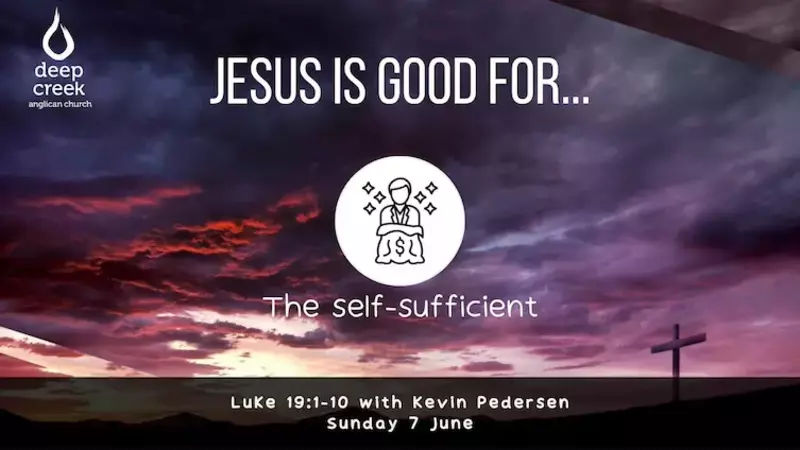
Jesus is good for the self-sufficient. I just love to hear stories about the way people, about the way that God works in people's lives. I love that. I think one of the best things about being a locum is you get to kind of cruise around and drop on people's kitchen tables and say, hey, tell me about you and how did you get to know Jesus? And it's just often like really amazing.
I came to the prayer night on Monday night and there are little posters on the walls about that. You want to work out what we were praying for, just have a look at one of those posters and add a sticky note if you've got the inclination.
And I met Vahid, who's in the building somewhere. Where are you, mate? Wave up. There he is. Who is a Persian man from Iran and part of his story, which I only heard a little bit of, of getting to know Jesus was he appeared to him in a dream. How's that?
I hear that's often the case with Iranians. So God's doing something in Iran, I know that the news is dreadful, but don't kind of overlook the fact that he's at work there. Maybe we just can't see it, but, but there are some visible signs and people from Iran and lots of Muslim countries actually tend to find out about Jesus because of a dream and lots of stories.
None of them are mine, I've heard them all, but, but it's great, it's great to meet you. That works for me. And so, so please invite me to your place. Okay. You know, make me a cup of tea. You make the tea. I listen. That's the deal. And we'll have a great time.
So as Rachel said, we're spending the next few Sundays looking together at the ways that Jesus is good news for different kinds of people. If you were this last week, it was the unloved. And we sat down with the woman at the well, just that beautiful story.
This week, we're thinking about the self-sufficient. So we might even have to just think about what does it, what's self-sufficient? What is that?
Well, that's just going to unpack that as we work our way through this encounter with, between Jesus and Zacchaeus.
Who was Zacchaeus? Zacchaeus was a man who thought he had made it. He thought he had everything he ever needed. That's who Zacchaeus was.
And then gave it all away. And then gave it all away. So that's the tension point. That's the huh part of the story. Let's think about that together.
When Dignity Climbs a Tree
First slide, there it is. So that's the known world. And the Roman Empire is the dark bit. So it's big.
The Roman Empire was a huge thing. And Zacchaeus was an important official in the Roman Empire. Kind of big, significant person in a big, significant system.
He was the chief tax collector, which meant that other people actually collected the taxes. They brought what they had collected to Zacchaeus, who kind of, you know, mushed it all together and gave the Romans their bit and kept the rest. That was a great deal.
Okay. So he was the chief tax collector, a very significant person in a very significant town, Jericho. It was like a trading route. Okay, so there was a lot of transit of goods and people through that town.
He had position. He had power. He had influence. He had security. These are all significant things and enormous wealth.
But what he also had as a collaborator, as the chief tax collector in this important town of Jericho, was the universal loathing of everyone in the town.
So he was the bad smell, right, at every party. He was the one that nobody wanted to know. They wouldn't acknowledge him. If he fell over on the street, they would probably step on him, right? He was that person.
So here's Zacchaeus. He had it all and he had no one to share it with. Can you kind of hear that?
He hears Jesus is coming to town. Jesus intrigued him. He wanted to see this Jesus guy, but there was a problem.
And if you've got your Bible open, you'll see immediately before the passage we heard read, as Jesus approached Jericho, okay, so what we had read is part of something. So you've got to imagine Jesus coming in.
As Jesus approached Jericho, there was a blind man. Jesus heals him. And the blind man, as you can imagine, you know, is jumping up and down and woohooing, okay, and the crowd who know him and have seen the change that Jesus has made in his life are all praising God.
Okay, so Jesus just doesn't kind of sneak into Jericho. It's like this rowdy procession with all these people jumping up and down, and a blind man in the middle of it all. And like, has anyone ever seen anything like this? And this is how Jesus comes into town.
So Zacchaeus wants to see Jesus, but like, it's like a throng. You just can't get anywhere near him and there's all this noise.
So Zacchaeus finds himself in the midst of a tumult of praise. And though he wanted to see who Jesus was, he was a short man and he could not because of the crowd, verse 3.
So what to do? Hmm. Now, Zacchaeus was the resourceful type. He'd worked his way kind of into the top tax collecting job.
So he finds a big tree, that'll be the next slide, and sits in it. He thinks he's going to get a view. He just wants to see this Jesus, see this guy that all the noise is about. So he gets himself a position where he can see him.
Now, it's interesting too because, you know, imagine you're Zacchaeus, right? So you're important. The system, the Roman Empire is telling you you're important.
Who knows? He might have had like, you know, a cord with a big medal or medallion here, or he might have had special kind of chief tax collector clothes. That would be important.
And because, you know, nobody liked him, he would trade on his dignity. Can you see Zacchaeus doing that? Can you see him? He's so important. Huh, huh, I'll look down on you lot. I've got a special jacket. You know how it works.
But look at him. Where is he? Is he dignified? He's like a bird in a tree. So something's happening for Zacchaeus.
If you know the story of... Sorry, this sermon will have to end eventually.
But if you know the story of, you know, the lost son, you know, when he comes back towards the father's house, the father runs out to him.
Do you know something that men of stature in Middle Eastern communities never do? Run.
So the cultural story here is something's happening in Zacchaeus. What's he doing in a tree? He'll get his special robe dirty. He's not looking dignified now.
So the wheels begin to turn.
There's actually a picture of the tree that Zacchaeus sat in, if you believe the tourist brochures. As you come into Jericho, there it is. It's a big one, isn't it? Ooh, yeah, it's a big one, isn't it? Okay then, all right, yeah, it's a big one. So really, Zacchaeus just wanted to see Jesus.
Jesus Calls Us by Name
But of course he was in for a surprise, wasn't he? Because even more than Zacchaeus wanted to see Jesus, Jesus wanted to see Zacchaeus.
So he ran ahead and climbed a sycamore fig tree to see him, since Jesus was coming that way. And when Jesus reached the spot, hands on hips, he looked up and said to him, Zacchaeus, come down immediately.
I must stay at your house today, must. Just follow the clues. Something's happening.
And so the crowd who were praising God one minute, who's ever seen anything like this? Fold their arms, go on you can all fold your arms, and they mutter.
Well go on. Okay then. This is not a popular move, Jesus. Don't you know this guy's a slimeball?
You might be new to town, but just look at his robe. He's got that big medallion thing.
All the people saw this and began to mutter, he's going to be the guest of a sinner.
But it's more than just unpopular. Okay, now Jesus cuts across a few social norms here. Somehow, Jesus' visit to Zacchaeus' home exposes him.
Right, so there's something going on inside Zacchaeus. It's not just look and see now. Oh, he's coming to my house. We're not told what it is, but he realizes that all he has worked to gain actually gives him nothing he really needs.
That all he has worked to gain, his kind of project, life project, has actually given him nothing he really needs. There's like this, like something that he had just never thought of before or never appreciated before or never realized before or hadn't ever seen before is suddenly before him like this, you know, freight train coming out of a tunnel.
There's this moment and I think Zacchaeus comes under the Holy Spirit's conviction and we see it.
He decides to turn around. He decides to repent. Somewhere along the line, he decides that what he used to think of as significant is not significant at all.
Have you had that kind of conversation with someone like ever in your life? Where someone who had kind of set on a trajectory, you know, they were doing good, it was all working out well and just turned away.
Or something they believed or were committed to or that was important for them or it was part of their, you know, culture or experience and suddenly they turned away. Have you ever had that experience? Have you ever talked with someone who's had that experience?
Like it's amazing. It's happening to Zacchaeus. What he used to think of was important and significant and kind of, you know, the reason for being. It's just not.
But he doesn't just stop there. He knows that a change of heart is followed by a change of behavior. Can we say that? A change of heart is followed by a change of behavior. That's true, isn't it?
I'm not going to do that anymore or I'm going to start doing this thing. And we know that repentance is followed by restitution and there's a slide for that too. So you see the Holy Spirit changes the heart which then changes the behavior.
Holy Spirit changes the heart and the heart changes the behavior. I don't want to do that anymore. I'm never going to speak to you like that again. And so one is repentance.
But what good is repentance without restitution? What good is believing something if you're not going to put it into practice?
So here's Zacchaeus. Is it you?
You see, when we come into Jesus' presence, it's like, you know, being in an elevator with too many people. You're squished up, right? And things start to show in the light of who Jesus is, you know, like a really good mirror, the one you should never look in when you're wearing glasses, you start to see stuff.
So here's this moment where Jesus comes up close and personal to Zacchaeus and there's a bit of friction. And Zacchaeus learns something about himself, something about his life, something about his priorities and he doesn't like what he sees.
So I'm going to give you a minute now. There's another slide. What do you think was going on in Zacchaeus? What do you think happened to Zacchaeus? What is that thing?
And you can draw on your own experience, you can draw on perhaps an encounter you've had with somebody else or a conversation or something you've read in a book or... I want you just to talk to one another or just sit there quietly yourself if that's you and just think, and then we're going to get some feedback.
So you've got two minutes, two and a half if I'm generous. Just talk to one another. What do you think was going on inside Zacchaeus? And then we'll come back. Off you go.
From Role to Relationship
All right. What's going on? Just yell it out. Where are we? What's going on? What's going on for Zacchaeus? Where are we? Who's first? I'll point to you. There's one.
We were thinking perhaps he had always had this thirst and he didn't even realise it. And then once he met Jesus, he suddenly realised it. Sure. He'd always had this thirst. He'd never realised it. And meeting Jesus. Right, let the fuse. Turned on the tap. Awesome. Yeah, sure. Cool. Yep. Sure.
Something about Jesus selecting him or singling him out, giving him that one-on-one. Okay. Yeah. Sure. Yep. Give peace to peace with grace and love. Sure. Yeah, the quality, Jesus' quality, grace and love. Yeah, we don't know the conversation. No record. Yeah. But we see the effect. Sure. Okay.
So you can imagine. You know, it's okay. You can think, well, what did they talk about? How did the conversation go? Yep. Because he didn't have a lot of wealth and he didn't have any friends. Nah. Yep. Yep. Sure. Yeah, rodeo. Sure.
So it's the unfulfilled promise. Okay. Yeah. Yeah. Sure. Have everything. It'll be great. Except it isn't. Yeah. Lonely. Great. Good job. Gee, you guys are smart. Yep. Anyone else want to kind of, you know, ruin everything? Any others? Yep.
The status and wealth becomes like an addiction for him to be able to have higher status and wealth. And maybe in that moment, thinking in front of Jesus, he had that moment of clarity that changed what he thought about what was important in his life. Sure. Yeah.
The status and wealth addiction thing. And then meeting Jesus, who just wasn't marching to the same tune, right? Jesus is just headed off in a totally different direction. Yeah. Yeah. Jesus gave him time. Jesus, you know, kind of knew his name. Was that a good thing? I don't know. Yeah. Right. Any others? Good. Thanks.
Okay. Let's look at the passage. One thing we can tell for sure, because the Bible kind of tells us in verse two. So the next slide, you can turn to your Bible. There it is.
Now, how is Zacchaeus introduced to us in verse two? That's a question. How is Zacchaeus introduced to us in verse two? What does it say about him? Thank you. Chief tax collector. Okay. So that's the beginning of the story. Okay. We go through the story. We pop out the other end. Next slide, please.
How is he introduced to us in verse nine? Sorry? Son of Abraham. Interesting. Interesting. At the beginning, we're introduced to Zacchaeus in terms of his role. It's the what do you do question at a birthday party, right? It's a role. Oh, you're a nurse. Oh, you're the chief tax collector. A role that gave Zacchaeus everything he thought he needed. He was happy, actually.
Then he had lunch with Jesus and that changed all that. And he comes to see that his role does not give him the thing that is most important of all. The thing that makes all the other things worthwhile. Which is? Not role, but relationship. Yeah. Son of Abraham. And that trumps, son of Abraham trumps chief tax collector. Okay. It just does.
Because you can have it all, but if you haven't got anybody to share it with, that sucks.
First, we see Zacchaeus, his relationship with God is restored. Do you see what word he uses to talk to Jesus when he addresses Jesus? What does he say? Hey, you, sorry? Lord.
What does Lord mean? What does that mean? If someone calls you Lord, what does that mean? Sorry? Yeah. King, ruler. It means you tell me what to do. Is that what that means? Lord? Yeah. Is that what that means? Sure.
Now, next time you're praying, I want you to work out what no Lord means and why that's a silly thing to pray. Because the Lord is someone who tells you what to do. So first thing, his relationship with God changes through Jesus, which is good.
And the next thing, his relationship with who changes? Who? Sorry? Again? The poor. And? Everyone he's cheated. So that's like the whole town. Come on. He's a chief tax collector. He's robbed them all.
Joining God's Salvation Story
So he gets his relationship with God right and he gets his relationship with his townsfolk sorted. That's pretty good lunch.
You see, like the woman at the well, his role had isolated him. That's it Tony, the addiction thing, you're onto that. And he had become its slave. Do you know that? Do you know the scriptures say you are the slave to the one you obey?
Sorry, you're not having a very good morning. So what are you obeying right now? Who are you obeying? You are the slave of the one you obey.
He's trapped. He's trapped in this excellent life he was having as the chief tax collector but it sucked because it didn't give him anything he needed.
So this is a real good news story. Zacchaeus joins himself to God's salvation story. There it is, verse 9. Jesus said to him, today salvation has come to this house because this man too, even this man, is a son of Abraham.
Who is Abraham? This is where you need your Bible again. Genesis chapter 12.
The Lord had said to Abram, leave your country, your people and your father's household and go to the land I will show you. I will make you into a great nation. I will bless you. I will make your name great and you will be a blessing.
I will bless those who bless you and whoever curses you, I will curse and all the peoples on earth will be blessed through you.
So Abraham left as the Lord had told him and Lot went with him. Abraham was 75 years old when he set out from Haran.
Okay so what's the thing about Abraham? Abraham is God's friend. Abraham is someone God talked to and then Abraham did what God said. Go figure. That's who Abraham was.
Someone who heard God's call and left everything he knew, his father's household, his tribe and his land and followed him. Like Abraham, Zacchaeus lives his old ways, his old life. He turns his back on them and follows Jesus. That's what repentance means, to turn around.
Paul tells us a little bit more in Romans 4. He makes the meaning of this and the promise Abraham carried plain. He says, so then he is the father of all who believe. Because that's what belief is. It's doing what God says and leaving the rest behind. That's faith.
That's the only way anyone ever comes to Jesus. To say, I prefer what you have. I'm gonna follow you. John adds this little nugget. Abraham's children are all who do as he did.
It's very kind of easy to understand. If you do what Abraham did then you are a child of Abraham and Abraham was God's friend.
It's always amazing when someone turns from their old ways, it could be a behavior, it could be a lifestyle and decides to follow Jesus. You know why that's so amazing? Because our pride, our self-sufficiency is so strong.
How many funerals have you been to where the theme song was, I did it my way? No really and we think that's good because you want to be a self-made man. You think about that. Self-sufficiency, pride, our belief in ourselves is so strong.
To turn to Jesus is so contrary to our nature, our natural selves, that stuff you do without even thinking about it. Paul says you have to die to yourself. The self is so strong you have to die to yourself. He uses crucifixion language. That's how hard this is.
To give up on yourself. Sounds great doesn't it? There should be a queue of people waiting to do that. How hard is that? And anyone who has been there, if you've done that, then I'm sure your testimony is eloquent as to just what a rough ride that is.
I'll tell you a story about a Vietnamese guy called Tien, not his real name. Buddhist background. I met this lovely Christian girl who I actually had in our Sunday school when we were in Bendigo.
Ended up at Ormond, got himself converted and wanted to be baptized. And the problem was, as the eldest son in a Buddhist family, he on marriage, and they were about to be married, on marriage inherits the responsibility to care for his ancestors.
Because when you're married in Vietnamese culture, you become a man and the oldest man has the responsibility for care of or worship of the ancestors and there's a little shrine in the house and that's just how it rolls in Buddhist culture. Except this guy had become a Christian and he said, Kev, I can't do that.
That's big in ways I don't even understand. So before the marriage, and I was doing the marriage, and before his baptism, and I was doing the baptism, his family got together with me and they wanted to find out what I had done to him. Really. I mean, they were caring for him.
It wasn't like, you know, they went out to get me or anything. They said, what has happened to Tien? What have you done to him? And you can imagine the way that conversation went. It was like being triangulated.
But in the end, all I had to say was, look at him. Everything he does, he does with a deep integrity. And it's true, that was his nature. He's just the most amazing guy. And I turned to them and I said, why would this be any different?
And they just went, oh, they got it. He'd seen the hope that Jesus holds out. And he'd said, I want that. And that meant everything else came second. Because he's just, he was full on. He just, that was what he wanted to do. And after that, there was no more objection.
So it's not always, you know, leaving the cushy career, right? With corruption or whatever it is. It can be, you know, there are all sorts of ways.
But when Jesus calls you, you've got to put that thing down, folks. Because he comes first. That's the only way.
Zacchaeus sees it, sees it in himself. And it causes Jesus to cry, the Son of Man has come to seek and to save what is lost.
And here's the thing we don't want to hear. Without Jesus, you are lost. You can be the best tax collector in Jericho. You can be the most fabulous heart surgeon in Melbourne. You can be the best kindergarten teacher in Ashburton. But without Jesus, you are lost.
You see what happens? Zacchaeus takes his eyes off himself, off his own needs and comforts, and starts to notice God and the people around him. That's the transformation.
Now this applies to us all personally. We all naturally put ourselves first. The first thing you think about when you wake up is you. And we naturally expect more of others than we expect of ourselves. We've all come across that.
But it's also true of communities, true of nations, and true of us as human beings.
And so just as, and it's nearly the end, just as Jesus was approaching Jericho and he came across a blind man and healed him, and there was this kind of enormous ruckus, as soon as the lunch with Zacchaeus draws to a close, your Bible says, while they were listening to this, okay, in the same breath, he went on to tell them a parable.
So you've got to link what happens to Zacchaeus to what he says in the parable. So let me just help you with that for a minute. The parable is about the kingdom. The parable is about somebody who goes off to be made king. The kingdom is coming, but the kingdom is not quite yet. Sounds a bit like now.
Jesus is coming, but he hasn't come yet. And this is really a message to the church. The parable makes clear how we ought to behave. We need to be good stewards with what is entrusted into our care. The parable makes clear what happens to those who don't want him to be their king, and it's not a very nice picture.
Knowing Jesus and knowing his forgiveness in our lives gives us a responsibility to steward that knowledge. It's a privilege. We will answer for it at the end, but it's entrusted.
Jesus is looking for a return on investment from his church. He's looking to those who have received the good news to pass it on to others to share it, to share their story of how God has been good to them.
I don't know what you think about evangelism. Here's what I think about evangelism. It's telling your story. End of story. That's really all you have to share, how Jesus is for you.
Zacchaeus had a testimony. We've just read it. If he's touched your life and if he's given you a testimony, you've got a story about who Jesus is for you and how he's changed your life and why that's important. That's your testimony. That's what you should be telling.
Please notice at the end of this parable, Jesus enters Jerusalem for the last time and we're in Holy Week. This is how he ends his ministry and starts his passion.
The parable, a takeaway apart from repentance and restitution and all those things that we should be doing is this. We, Deep Creek Anglican, we've been handed a great treasure. We have the knowledge of Jesus Christ in our hearts.
You will answer for that. What did you do with that? Jesus says, doesn't he? I've come to seek and save the lost.
His sharing of new life with you was only the beginning. It's not the end. That's the beginning. He set the ball rolling.
Think of what he wants to do in you. Think of what he wants to do with you. Think of what he wants to do through you. That's the point of the parable. It just grows from here.
Now we need to rely on him, we need to look to him, we need to trust him. Yeah, yeah, he's the one who does it, but he does it through us.
The greatest joy you can ever know is to know Jesus and then to help others know him too. It's the reason he came, to seek and save the lost. And that great charge is entrusted to you and me.
Isn't that exciting? I just think that's amazing. Who knows what he will do?
Friends, the Lord be with you.