Read the transcript
Bible Readings
Psalm 78:2-7
"I will open my mouth with a parable. I will utter hidden things, things from of old, things we have heard and known, things our ancestors have told us. We will not hide them from their descendants. We will tell the next generation the praiseworthy deeds of the Lord, his power and the wonders he has done. He decreed statutes for Jacob and established the law in Israel, which he commanded our ancestors to teach their children. So the next generation would know them, even the children yet to be born, and they in turn would tell their children. Then they would put their trust in God and would not forget his deeds, but would keep his commands."
Mark 10:13-16
"People were bringing little children to Jesus for him to place his hands on them. But the disciples rebuked them. When Jesus saw this, he was indignant. He said to them, Let the little children come to me and do not hinder them, for the kingdom of God belongs to such as these. Truly I tell you, anyone who will not receive the kingdom of God like a little child will never enter it. And he took the children in his arms, placed his hands on them and blessed them."
This is the word of the Lord.
Introduction
Well, good morning, everyone. My name is Karen. It's great to be here this morning. I just feel like Megan has arranged this so nicely that I get to be here when we commission all your kids and youth ministry leaders. What a joy to be here.
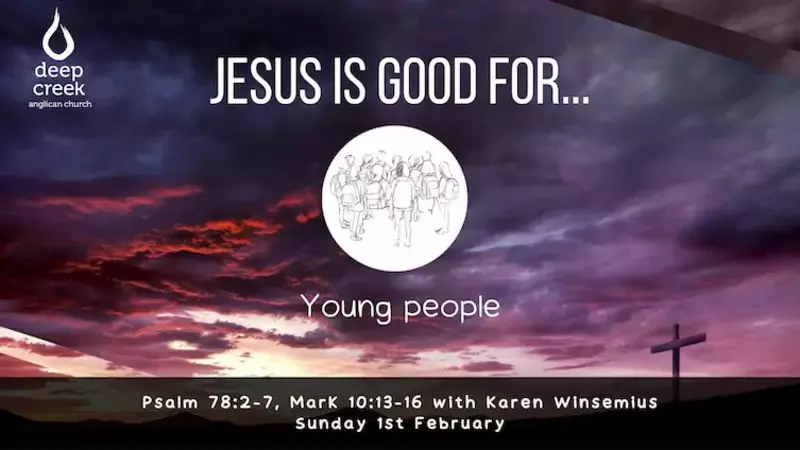
Well, today we're exploring a topic that hopefully is a bit of a no-brainer. Jesus is good for children and young people. Like, I feel like we could be like, cool, tick. Sermon done. But, you know, there's a bit more to it than that.
A Personal Faith Journey
But I thought I'd begin today by telling you a little bit about my faith story. I was that super keen Sunday school kid. It's a little bit embarrassing, but like I was the kid that sat at the front. I always knew the answers, you know, probably because it was always God, Jesus, the Bible. I just, I felt like this was my place, you know, sometimes school, it didn't always, you know, we moved around a lot, but church, this made sense to me.
Except that when I was about eight, I remember having this question. What's all the fuss about Jesus? Like I sort of just didn't really get it. Mostly, I think I was getting a bit bored that every week the stories were the same. Why are the stories always about Jesus? Can't we have a story about someone else for a change?
I've heard this story before. You might be thinking, oh my goodness, I've heard that story from Mark chapter 10 before. Oh no. But I never really told anyone as an eight-year-old that I was getting a bit bored at Sunday school.
Thankfully, time passed and I actually belonged to a congregation that were just so warm and welcoming. Despite my young age, all the adults in our church, they just loved everyone. They would come up and ask me how my day was, what was going on, how was school. They just treated me like a person.
And then a few years later when I was in year seven, just a few things started to shift and maybe almost line up. It's like I had all the pieces of the puzzle and it just took a little while to like put them together. So when I was in year seven, I started serving on a kids ministry team at the ripe age of 12. It was great.
We got a new kids minister that year and he started a kids holiday program. But one of his key passions was raising young leaders. And so all of us as teenagers got invited to join the team and he worked so hard at making sure that we were nurtured and encouraged through that process of learning to lead. And I also did youth alpha and I feel like all of these things sort of fitted together and I was like, ah, maybe this is why we're always talking about Jesus. Maybe it's not that they haven't run out of stories. It's that it actually it's all about Jesus. That's why we serve. That's why we come in community together.
And it all just sort of clicked. And the people were good. But Jesus is really good. And that was so important for me, because as I got a bit older and, you know, things got a bit more tricky, some difficult things happened in life. Some of those things could have really derailed my faith.
Both my parents stopped going to church when I was a teenager, and so I had to make a really conscious decision. Is this actually something I want to choose to say yes to? And I think having those experiences and having that those seeds sown in that I was a valuable member of this church community, that this was a faith that I could I could really grasp and understand for myself. Those became like this foundation stone for me, which meant that when those hard things happened, it didn't mean that they weren't hard or they didn't affect me. But my faith was so grounding during that time.
I wonder what your faith story is. Who are the people that helped you along the way? So much of what we're going to talk about today is about not just our individual relationship with Jesus, but also the people around us that help walk with us.
Who Gets Jesus’ Attention?
So let's turn to our first passage. We're actually actually we're going to start with the second one. We're going to start with Mark and then we'll flick back to Psalms a bit later.
But this story in Mark chapter 10 is so well known, but it's so well known for a reason. It's such an encouragement to us. But I think it's actually a story of attention, paying attention. Who gets Jesus' attention? Who's worthy of Jesus' attention?
Now, the whole way through chapter 10, in fact, most of the Gospels, really, it's these crowds of people following him. Following Jesus, vying for attention. They just want a moment to talk to this man. Hoping to ask a question or to have Jesus heal someone that's close to them or themselves. And sometimes maybe just to prove that they're important. And I think this story in particular highlights sometimes our measure of what we value in who we give attention to. And sometimes what we value isn't actually on the money.
Now, over the years, I've spent quite a bit of time with toddlers. And toddlers, you know, they want your attention, don't they? A few years ago, I was while I was finishing my studies at Ridley. I did some babysitting over the holidays for a friend of mine that had a four-year-old.
Now, have you spent much time with four-year-olds? Most of them, their favorite word is why. But why? Karen, but why do I have to have a nap? Why do I have to eat cheese? Actually, no, that was never a question. We loved cheese.
One of our conversations went along the lines of:
- Karen, why is it hot today?
- Well, Harry, it's summer. It's hot in summer.
- Yeah, but why is it hot in summer?
- I suppose that's a good question. I mean, it's summer. It's probably got something to do with the atmosphere and where the sun is in the sky.
- Yeah, but Karen, why? Why is the sun hot in the sky? Is it really?
I don't know if you've been on the receiving end of these why questions, but they really put you on the spot and they test your knowledge really quickly. But why does it matter, Karen, where the sun is? I don't know. I think that's just the way our solar system works, something like that. But why, Karen?
The why questions can be really intense. But actually, what was going on there was wanting relationship. This small child, Harry, wanted relationship. He wanted to keep the conversation going. And why is a great way to keep a conversation going. I very quickly got to the end of my knowledge on a lot of our conversations, actually. But that's OK. But I think actually what was going on there was not that this small child needed to know exactly how the sun and summer worked. He wanted to keep talking. He wanted to be friends. He wanted to know that he was valuable. Because where we give our attention shows our affection.
And I think here in this story, we see the people who want Jesus' attention. Now, at the start of chapter 10, we see the Pharisees do this in a particular way. They ask tricky questions about the law. That's the way they build conversation, right? But it's the same with the rich man from verse 17. He also wants that moment of conversation with Jesus. There's something about Jesus, right? The people want to be near him.
And so in our passage, we've read that people bring their little children to be near Jesus so that he can place his hands on them. They value their children. They're hoping to have Jesus see that value, to show value as well, to show affection. Now, in Jewish families, children are a really integral part of the family. They do so much together. But their value in wider society is not always clear. It's not that they're not important. But it's not the same as the household dynamic.
And we see that really clearly in the response of the disciples who were like, yeah, off you go, out the way. Their families love them. But in society, children aren't given as much cred as they are in their family unit. And certainly not with this famous rabbi who everyone is vying to be around. These parents are disrupting the social order by bringing their children to Jesus.
And here's this amazing response that we see. Not only does he notice the children, he goes over and above the parents' request to just place his hand on them. So in verse 16, we read that Jesus literally takes them in his arms. He places his hands on them. And he blesses them. So Jesus sees the request. He notices the children. He gives them attention and affection.
Is Jesus good for children and young people? This passage says yes. Jesus raises the bar, not just a little, but three times as much as what was asked for. This is a story of attention. And Jesus shows who is worthy of attention. And it's not what would have been expected. The lowly are raised up. They're given honour. And it would have been totally unexpected. Jesus has this love to offer to everyone, even those who are ignored by others.
Attention in the Digital Age
Now I wonder, what does attention look like in our world? The contest for attention is only growing. Everything, everyone is vying for our attention. It's not always a good thing, right? Advertisers have known this for a long time. Social media has perfected this craft, right, of grabbing and holding our attention. And you just end up scrolling and scrolling through countless cat videos. Attention is affection, but is it always?
Have we made a choice in that? We're instructed in Philippians 4 to dwell on what is good, pure, noble, right, lovely, praiseworthy, and excellent. Now the cat videos are hilarious, I do love a good cat video, but they probably don't fit into any of those categories. And yet they take up so much of our attention. Where does that leave us? Where does that leave children and young people today?
Because there's no doubt that the attention of children and young people is highly sought after. Unfortunately, it's not always for honourable reasons. Just there's some broad estimates about the value placed on children and young people's attention from social media, and it's placed in the billions of dollars of revenue. Like that's, these are astonishing numbers of how much is being taken. This is the money to be made from those under 18. Because if companies hook them in younger and younger and younger, they get the whole family, but they get customers for their entire life. That's the power of attention.
And I think that leaves us with a few uncomfortable questions. What do we, do we value attention? Do we give attention? Do we vie for attention in the same way? Do we have honourable motives? Do we give attention to children and young people? And is Jesus our model for that? Hopefully our model is not the social media companies.
I think we'd like to say, yes, Jesus is our model for how to give good attention to children and young people. But then what does that look like?
- Do we listen to the thoughts and opinions of young people?
- Do we intentionally ask them just how is their life? What's going on?
- What have they been reading in the Bible?
- Do we take their suggestions about how to do church seriously?
Jesus is good for children and young people. And by offering love and attention, I think we get to show that we value them. We show them affection as well. They're not just a commodity. Jesus gives a model of genuine affection.
Equal Inheritors of the Kingdom
But I think that's not the only way we see that God, that Jesus is good for children and young people. Jesus not only notices them and shows them value as autonomous individuals, Jesus elevates them and holds them to us as an example of faith. Let the little children come to me and do not hinder them. For the kingdom of God belongs to such as these. Truly I tell you, who, anyone who will not give attention to children and young people who anyone who will not receive the kingdom of God like a little child will never enter it.
Once we see, once again, we see that Jesus reverses this cultural norm and understanding. It's not how smart or wealthy or well-connected someone is that gains them favor in the kingdom. Childlike faith is being held as an example to all ages. Children aren't being let in out of pity or just like in the last moment. They are equal inheritors of the kingdom of God. Like we're all made in the image of God. And children back in the day, children like this was a shocking statement because children were not seen as equal. They hadn't sort of proven themselves because they hadn't been out of work. Or contribute to the household in the same way that adults had. That was the value of culture.
But Jesus is good for children and young people. He reverses that expectation that your worth is determined by what you do or by how smart you are. And by allowing children to come near and to be valued as they should, we see Jesus honor children as examples of faith to us. Jesus gives them a voice in a time where they are voiceless.
Now, I think over time, we've seen the status of children and young people sort of shift gradually. And particularly maybe in like Western culture. But I think we've seen them go from being not seen and not heard. You know, they sort of pop out as grownups when they're allowed to take a job, which back in the day might have been like 14. And now and then they sort of shifted to maybe seen but not heard. You know, I think Von Trapp family, they would come out, perform a musical item and then go back upstairs where they wouldn't disturb the grownups of the world.
But actually, we are moving to a time where children are both seen and heard. They are an equal part of our society. And this is actually even mandated in our Victorian child safe standards. So standard three says, children and young people are empowered about their rights, participate in decisions affecting them and are taken seriously. Like it's quite amazing, actually, that we have a government mandate to listen to young people, which makes me think we were not doing that before. We're required to do this.
But as Christians, we have an even greater reason to listen to young people. An even greater reason to value them because we are equal. We are all made in the image of God. We are all examples of faith to each other. And in fact, children are raised up and held as examples of faith to all of us. Jesus challenges us to be not swayed by status or hierarchy. And like, I actually think we all know this, theoretically, right? It's how do we practice this?
There is no junior version of being a Christian. There is no mini Holy Spirit that dwells in the under 18 and you all of a sudden get an upgrade. Jesus tells us that the kingdom belongs to children. We should see them as examples and we should take the time to listen.
Learning to Listen
And I wonder like who listened to you when you were young? Who paid attention? Who asked you about your life? Who asked you what you thought about faith? Like those are special people in your life, right? I can think of people in my life that I'm so grateful for. I can think of people in my life that I'm so grateful for, for the way they treated me as a person. Do we take the time to be those people for our children and young people now? Do we take them seriously?
I love chatting with kids about the Bible. Just feel like I should make a confession because I'm standing up here preaching is that I probably get more out of chatting about the Bible with a bunch of kids than sometimes listening to a sermon, but that's counter to now I want you to listen to me. So sorry everyone.
But a few months ago, so I was previously working at a church in Caulfield and I was chatting to the kids at my kids' church. Now they knew me quite well by now and we were talking about the story of Elijah and the prophets of Baal, so Old Testament prophets. And one of the seven-year-olds, seven-year-old girl asked me just out of the blue during the discussion, Karen, why does Jesus pray? And I was like, I mean, that's a great question. I'm not sure why it's come up now. So can you tell me a bit more about this question?
And so she explained a little bit that like if prayer is talking to God and asking for things and like explaining the situation. Like Elijah talking to God to explain the situation that he was in and he needed help. Like if that's prayer, why does Jesus need to pray? Because isn't Jesus God and Jesus should, Jesus should know all the things and because Jesus is God. And so why does, why does Jesus need to pray if prayer is asking God for things? Wouldn't Jesus, wouldn't God and Jesus just know all the things already?
And I was like, well, that's a great question. What do you think? What do other people think? And they were just like, no, Karen, we don't know. Just tell us the answer. We're confused. And I was like, I mean, fair. It's a good point.
But we, we had this amazing conversation about prayer. What's the point of prayer? And so we ended up discussing like the different reasons to pray. You know, it's not, it is asking God for things, but also it's about communing together. You know, you don't ignore your bestie until you just want something. You want to be with them all the time. You want to be talking. You want to just share life, just chat about the random things that are going on.
And so when we had that conversation, it was like, ah, I mean, maybe. We, we summed it up. I'm fairly sure by the end of the conversation, she was like, look, I'm just not convinced. She often did, but I learned so much from that conversation. It's still stuck with me. What is, what is the point of prayer? How often do we pray? Do I pray with the motive of just hanging out with God? Anyway, like the, the questions really spiral when you start to go down that tangent. But talking to children is so great because they see things from a different perspective. They will have questions that I haven't thought of. And that makes me a better Christian. It helps us get outside our cultural bubble, our generational bubble to ask and engage with someone who is of a, in a different life stage than we are.
Cultural Lenses and the Bible
And now recently, in fact, a week or two ago, there's an organization called the Youthscape, and they released some research on reading the Bible with teenagers. And these teenagers are not Christian, don't have a Christian background. And they asked the question, does Jesus and the Bible sound like good news to young people outside the church? Now the research tells stories, I think, that need to be listened to. Now the research tells stories, I think, that need to be listened to.
The research sort of broadly found that whilst Jesus was mostly a positive figure, perceived as a positive figure, the church unfortunately was perceived as a somewhat negative figure, a negative place. It can be uncomfortable for us to hear this. But it also had quite complex and quite confronting comments about the God they encountered as they read the Bible. So the young people that were involved were broken into small groups, and they each read one story.
And so one group read the story of Jonah. Now we like to think of the story of Jonah as a story of mercy for the people of Nineveh and of God working and walking alongside Jonah as he works out his role. Well, the young people that read this story were quite concerned about how violent God seems in this story as God causes a storm and tragedy for the people on the boat who just are just going about their business. They were also concerned at the lack of respect given to Jonah's autonomy to say, no, we live in an age of consent. And so how do we understand individual autonomy with God's sovereignty? It's a really tricky question. And if we've only read the story of Jonah through the same Christian language over and over again, we miss that point.
What do we do with that? The story of Jonah is held up as a story of mercy. But is it good news for Jonah? The teenagers who read the story were not convinced that this was a good news story.
Now, this is just one example, and it was only a small group of young people. But it does give us pause to think, what are our cultural lenses? What are our generational lenses? What are just our like, we've been a Christian for a long time lens? It is more and more important to listen first. Jesus commands it of us. And it's a good practice to remember that our own insight into the way we read the Bible is not the only insight. Are we coming with a posture of learning when we engage in the Bible with children and young people? Do we see ourselves as genuinely equal, which means that the Holy Spirit is revealing things to them that he might not have revealed to you. The Bible has so much good news to offer to children and young people. And we need more and more skill and time and listening to do that work of engagement.
Intergenerational Faith Community
And I think that brings us to our third area that I want us to just talk through this morning, which is that children and young people are a genuine part of a faith community. And that that is another way that Jesus is good for children and young people. We live in this world of hyper individualism, of increased rates of anxiety, and this pressure to create a new you just all the time. And I think we saw in our psalm just this real sense of community, this commitment to community that is in stark contrast to the world. It provides a way to find identity that is not based on just creating it in and of yourself. And it's done in person, face to face. It's awkward. We're all a bit awkward, right? But Psalm 78 gives us a push to keep going, to know that the value of being together outweighs any sense of awkwardness or, you know, things aren't done exactly the way I want them to be done. Because actually, the goal of being together is that we are committed to being the family of God together.
Psalm 78 gives us this picture of intergenerational community, not just in the one snapshot moment, but it talks about the descendants before and then the children yet to be born and then their children. This is multiple generations that they're talking about. And it's this intentionality to foster ongoing community, to share the love of God with each other.
And I think this picture of the kingdom of God is like a safe haven compared to the culture we currently swim in. Now, the values of autonomy, self-expression, safety, creating identity, these are all good things. They're not bad. It's not an either or. But I think they're often pushed to the extreme end. They're often done in a digital forum where you then don't have people around you to like ponder, what does this mean? How do I do this? What does it mean when I'm interacting with someone face to face? We all have to work out our identity and who we are. But if we're only doing that online without people supporting us, that's hard.
And I think that's why this Psalm is so important for the church now. We will tell the next generation the praiseworthy deeds of the Lord. We're actually inviting people into a story bigger than themselves, a story that is centuries, millennia long, that will keep going for eternity. There is a high expectation in this Psalm that the generations will relate to each other regularly, honestly, openly. I imagine that they had fights sometimes. They didn't always agree. They probably disagreed on the music. But that's OK. Because there's real relationship.
There's relationships where the older members of the community, whether that's in age or stage of life, are genuinely committed to sharing their faith with those who are younger. And so as young people wrestle with questions of identity and faith, this Psalm upholds that special role that all of us have to walk alongside. It might not be by telling them what to do, but more about sharing stories of life together.
And I wonder who walked alongside you? Who were those people in your life? Are they still around? What a joy to have people who are committed to walking alongside us. If you've been a Christian, I don't know, even longer than a week, we all have this shared commitment to being those people who walk alongside others, a responsibility to share the good news of Jesus with those younger than us.
Conclusion: A Church for All Ages
And as a church, we actually have a corporate responsibility to this as well. We have a responsibility to create an atmosphere that is welcoming for all ages, welcoming for all stages of life where we can share faith together. Sometimes it means we have to give up our own preference, put the needs of others ahead of us. Sometimes the church hasn't always been good at this. And across the Melbourne Diocese, we have a ways to go. Sometimes we just rely on the staff to make it happen. But this is a collective. This is the whole church caring for the whole church. When all generations thrive, when all generations are invested, and it will happen when all generations feel loved and welcomed.
So is Jesus good for children and young people? Absolutely.
- Jesus encourages us to pay attention, to give our affection to the children and young people in our lives. In our midst, because he paid them attention. He said they were worth paying attention to.
- He gave them his affection. The offer of salvation is open to any age and stage.
- Jesus held up children and young people as equal inheritors of the kingdom of God and examples of faith to all of us.
- And he encourages us to genuinely listen and to actively grow an all age community of believers that passes on real faith, lifelong faith to all ages.
Closing Prayer
And so as you consider what that looks like for you guys here at Deep Creek, let me take a moment to pray for you.
Lord God, we thank you for Jesus, that he is good for children and young people. That he models for us the love and care we can show to those around us. Strengthen the children and young people in our churches, our homes, our community, that they may grow in grace and be full of your Holy Spirit. Increase in them the spirit of wisdom and understanding, discernment and strength as they navigate their daily lives and seek to follow you in a complex world. Help them as they consider Christ and what it means to be a believer today.
And we pray for this church to be a welcoming place for people of all ages. We pray for children and young people to feel valued and loved as they grow and participate here. Help each of us to continue to love Jesus and love each other. And we pray this in Jesus' name, amen. Amen.