Read the transcript
Bible Readings
This morning we have two readings from God's word.
Reading: Isaiah 2:2-5
The first from the book of Isaiah, chapter two, verses two to five.
In the last days, the mountain of the Lord's temple will be established as the highest of the mountains. It will be exalted above the hills and all nations will stream to it. Many peoples will come and say, come, let us go up to the mountain of the Lord, to the temple of the God of Jacob. He will teach us his ways so that we may walk in his paths.
The law will go out from Zion, the word of the Lord from Jerusalem. He will judge between the nations and will settle disputes for many peoples. They will beat their swords into plowshares and their spears into pruning hooks. Nation will not take up sword against nation, nor will they train for war anymore.
Come descendants of Jacob, let us walk in the light of the Lord.
Reading: Ephesians 2:11-22
The second reading is from the book of Ephesians, chapter two, verses 11 through to 22.
Therefore, remember that formerly you who are Gentiles by birth, called the uncircumcised by those who call themselves the circumcision, which is done in the body by human hands, remember that at that time you were separate from Christ, excluded from citizenship in Israel and foreigners to the covenants of the promise, without hope and without God in the world.
But now in Christ Jesus, you who were once far away have been brought near by the blood of Christ, for he himself is our peace, who has made the two groups one and has destroyed the barrier, the dividing wall of hostility, by setting aside in his flesh the law with its commands and regulations.
His purpose was to create in himself one new humanity out of the two, thus making peace, and in one body to reconcile both of them to God through the cross, by which he put to death their hostility. He came and preached peace to you who were far away and peace to those who were near, for through him we both have access to the Father by the one Spirit.
Consequently, you are no longer foreigners and strangers, but fellow citizens with God's people and also members of his household, built on the foundation of the apostles and prophets, with Christ Jesus himself as the chief cornerstone. In him the whole building is joined together and rises to become a holy temple in the Lord. And in him you too are being built together to become a dwelling in which God lives by his Spirit.
This is the word of the Lord.
Welcome and Introduction to the Series
It's great to see you. If I haven't seen you already this year, Happy New Year. And if you're new or visiting, a big welcome to you from me. My name is Megan. I'm the senior minister here at Deep Creek, part of a great team.
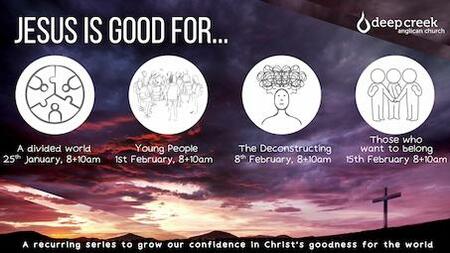
We have this series, Jesus is Good For, and it's going to come up a few times throughout the year because he's good for so many things. The reason why we have this series recurring is because our theme for the year is Jesus is good and good for you.
I felt that we needed this foundation before any of the things that we might try and motivate ourselves to do or any of the New Year's resolutions that you might have:
- Spending more time with God
- Having God at the centre of your household, your family, your work
- Being able to share about Jesus in a natural way with those around you.
All of these things really only happen when we have confidence that Jesus is good and good for us and others. We aren't able to prioritise him. We aren't able to invest in ways that maybe sometimes are a bit uncomfortable or certainly different to how we are encouraged to structure our lives by the media or by those that are trying to sell us things.
We need to know that he is the best choice, the truest way for us to be flourishing as human beings and indeed be all that we were intended to be in the sight of our creator.
A Context of Global and Local Division
We are starting with Jesus is good for a divided world.
When we chose this topic, yes, in my mind I had this weekend because it was Australia Day and we often have really divided views on what it means to be Australians, what it means to celebrate this national day at the same time as recognising those that were sort of left behind in this nation-making project that came from Britain and then of course that has grown through much multiculturalism over the years and we celebrate what an amazing place it is to live in Australia.
But we've started to see some of the cracks if we hadn't seen them before and so it's a very timely theme, thinking about Bondi and then of course thinking about our world.
If you're new or visiting here, we have a Farsi language ministry to the many Iranians who live in this area and we know that it's a very challenging and violent time in their homeland at the moment. But it's not the only divisions that we've been living with around our world, of course Israel and Palestine. We think about civil war, we think about Ukraine and Russia and where governments have made decisions and policies that seem to be dividing people within the nation themselves.
So I wanted us to ask ourselves, is Jesus good for a divided world or is that original vision that John Lennon sang about in his song Imagine, where if we had no heaven, no hell, no religion, then people would live their lives in peace.
Does Religion Cause Division?
Is Jesus good for the world or does religion, does Jesus even cause division? Now certainly we can see that religion has brought about all kinds of conflict and violence around the world. No one should deny that and Christianity is not exempt from that charge.
Those that look at the conflict in Israel and Palestine wonder if there is ever to be a solution when there is a religious story told by both sides about whose land it is and what it means to live the flourishing life in that land.
But of course if we were to look at the scriptures, we would see that the intention of God at every point was for every nation to be included in the flourishing plan that he had for humanity.
We've just finished a series on Abraham going from Genesis 12 to Genesis 22. There's other parts of his story and you can look at those yourselves. I highly encourage it. It was a great series, very encouraging for me to spend some time seeing God's goodness to Abraham.
But the challenge that we might sometimes have is that we see God creating a nation for himself in Genesis, but actually that's not the vision that God gives to Abraham. God says, I will bless you. I'll make your descendants great and every nation in the world will be blessed through you.
God's rescue plan as it starts to be stepped out from this man Abraham is not to choose only one nation who would receive his blessings, but that through that nation the whole world would be blessed, that division would be overcome.
The Biblical Vision for Unity
The reading from Isaiah that we had before our Ephesians reading, thank you Glenn, talks of a final last day's vision where not just many people will come and say, come, let us go up to the mountain of the Lord, but many peoples, nations, all kinds of different backgrounds, languages, skin colors, cultures, coming to God and having him as the one who settles disputes, judges between nations, and then brings unity where there has been division.
This image of beating their swords, their kind of symbol of being against one another into plowshares, that is agricultural equipment, tilling the earth, cooperating in what makes good life for people, all people. Nation will not take up sword against nation, nor will they train for war anymore. This is the vision of the scriptures from start to end, and of course if we were to go right to the end in Revelation, we see that God's intention is for there to be all kinds of languages and tribes and peoples around the throne of God.
A Radical Foundation: The Image of God
But this global vision is not simply a lovely thing for us to aim towards. It comes from a radical foundation. Now you won't think this foundation is radical, but it is. The radical foundation is that all human beings of every nation, every color, every language were made by God, loved by God, and share the image of God.
Genesis 1, Genesis 2, the very first chapters of the Bible, teach us that the vision that God has when he chooses Abraham and the kind of rescue starts is actually based in the fact that every single human being from every nation, even those that can't get along, is made in the image of God, has dignity, has infinite worth, is blessed by God when they are given life, every person. And so there is a radical equality and dignity for all humans that is the foundation.
Now I said you might not think it's radical. It's sort of the foundation now of our human rights. But in the ancient Near East, so what it was like when Genesis was written, there was only one person who really imaged God and that was the king or the pharaoh or the chief. And maybe some of the people in power got a little bit of extra flow down, trickle down dignity as it were.
But even when Jesus is born into the kind of Greco-Roman culture, the move away maybe from just the king or the emperor and thinking about the Greeks trying out democracy maybe. Well, people were equal only if they were the boss of their household at that time. And Plato said, nature tells us that some people are just more worthy than others. Those that are powerful, those that are strong, those that can rule, men, rich men, not slaves, nature just tells us that it's okay for them to be the ones who are treated with more respect and more dignity and we make decisions based on that.
You might enjoy this book that I've been enjoying, The Air We Breathe by Glenn Scrivener. And it talks a little bit about some of these things. It's really accessible. It's quite new. And you're welcome to come up and have a look at it after the sermon if you like.
So this is a radical foundation actually that wasn't shared in the surrounding cultures either when the Old Testament was written or when the New Testament was written, that every human being is made in the image of God and worthy of dignity and respect and that there is more that unites us than divides us.
What Went Wrong? Pride, Fear, and Greed
And so with this vision and mission for the Jewish people and with this radical foundation, what went wrong?
Well, when you are given a great gift, Tim Keller says, you tend to get quite proud of that gift. And so his concern or his concern was that the Jewish community diagnosis, that's the word I was looking for, his diagnosis of the problem with when Abraham was given this great gift of a mission of knowing God and then they were given the law and they had this incredible way of being close to God through the sacrificial system, they became proud.
And so they looked down on those who did not have access to God and the way that they did. So of course we do see that in the prayer that Pharisees would pray, thank you God that I wasn't born a Gentile or a dog or a woman because I have these, I have access to these gifts that you have given me. And I by virtue of receiving them must have been a bit more worthy than others and I feel superior to them. And so this is a great gift.
Well, I think that's right, but I also think there are some other things going on. I think that we get afraid when we have something special within our culture, within our nation, prosperity, safety, whatever it is, and we see those that we might be asked to include into that as a threat.
And that's really hard because there was a division between who could enter into God's presence and who couldn't. And so if you without God's grace start to interpret that as there's a threat of contamination, there's a threat that they will take from me, pollute what I have, or require more of me than I can give.
So you and I might not think of things like pollution and holiness when we are called to bridge a divide, but we may think, I just, I don't know what I'm going to lose in this. What have I got that I need to protect?
And then of course there's just general human greed. I have something, but I like also what you have. Maybe even more than I like what I've got. So for example, I don't know, you've got vast mineral reserves in your nation. I'd like it.
And then when we think like that, what we need to do is make sure we don't think about those people who have something that we want as really people. Because if you do that, if you think of them as exactly the same as you, it makes it a lot harder to do some of the rough stuff that you intend to do to get what you want.
And so when we're afraid or when we're greedy or when we're proud, then we find that divisions grow and grow and grow. Of course. And we make people into subhuman others in order to get what we want and to justify how we think of ourselves and them.
Jesus Challenges our Division: The Good Samaritan
But Jesus, when he comes into human culture, challenges our division and restores that global vision. He sees a nation that is divided, but that is not simply divided among racial lines, but that within it, it is divided between powerful and weak, rich and poor, sinner and righteous. He of course challenges the fact that those who have the great gift of the law and the word of God are not reaching out to others. And he restores the global vision.
On one occasion, an expert in the law stood up to test Jesus. Teacher, he asked, what must I do to inherit eternal life? What is written in the law? Jesus replied, how do you read it? The expert in the law answered, love the Lord your God with all your heart and with all your soul and with all your strength and with all your mind and love your neighbor as yourself. Do this, you have answered correctly, Jesus replied, do this and you will live.
This is the global vision and if we were to all do it, absolutely, Jesus says, you are so right. Love God, love your neighbor, done. No more war, no more injustice, no more hunger, no more poverty, done.
But the expert in the law wanted to justify himself, so he asked Jesus, and who is my neighbor?
In reply, Jesus said, a man was going down from Jerusalem to Jericho when he was attacked by robbers. They stripped him of his clothes, beat him and went away, leaving him half dead. A priest happened to be going down the same road and when he saw the man, he passed by on the other side. So too a Levite, another religious server, when he came to the place and saw him pass by on the other side.
But a Samaritan, as he traveled, a foreigner, came where the man was and when he saw him, he took pity on him. He went to him and bandaged his wounds, pouring on oil and wine. Then he put the man on his own donkey and brought him to an inn and took care of him. The next day, he took out two denarii and gave them to the innkeeper, money, coins. Look after him, he said, and when I return, I will reimburse you for any extra expense you may have.
Which of these three do you think was a neighbor to the man who fell into the hands of robbers? The expert in the law replied, the one who had mercy on him. Jesus told him, go and do likewise.
Here Jesus challenges the division in a people who felt that they were the chosen people of God and yet when they were not loving their neighbor because they defined their neighbor away. In their pride, in their fear, and in their greed, they defined their neighbor away. It could happen to the most holy of them. A priest saw a person in need in the story and passed by on the other side. A Levite, another religious person, passed by on the other side.
But only a foreigner took care of this Jewish man who was going from Jerusalem to Jericho. And he did so at great cost to himself. So that sense of threat that someone, if I'm going to bridge a divide, there will be something required of me, is true. This man had to give his own resources, used his own stuff, and then went into debt to the innkeeper. I'll come back and pay the bill later.
But also he had to go into threat of his own well-being because if you touched a dead body, we didn't know whether he was dead, if you touched a dead body, you were ritually impure, so you couldn't go and do your good things before God. But maybe even more than that, if there were robbers that beat this guy, who wants to say they're not hiding in the bushes and going to do the same to you? There's a great threat in his being a neighbor to this person.
But Jesus holds him up as the true way that the global vision of loving God and loving neighbor was to be lived out. That pride and fear and greed were all to be put aside so that unity could overcome division and true human flourishing could be restored.
Jesus is Our Peace
But I think we would say that challenge and vision is not enough. Jesus lived this out absolutely and you see him connecting with people across all kinds of divides. As we've said, rich and poor, sinner and righteous, gender, background, language, religious purity. But he did not come to be either just an educator restoring a moral vision or an example. This is how it is good to live because without a radical change in how human beings operate, the best and the brightest vision and example does not change us.
So that's where Ephesians 2 comes in and it's okay if you can't read the whole thing. Let me do a little plug here. We're creating little Bible booklets for all of our series this year. So do, if you want to, you can have one of these and the Bible readings are in it, some other ones as well. You can take it home and pursue God through his word. So you could have it there.
But what we're, come back, Jesus is not simply an educator or an example. Jesus is, Paul says, our peace.
Remember that formerly you who are Gentiles by birth and called uncircumcised by those who call themselves the circumcision, a bit of pride maybe, remember at that time you were separate from Christ. It is true. Excluded from citizenship in Israel and foreigners to the covenants of the promise, without hope and without God in the world.
But now in Christ Jesus, you who were once far away have been brought near by the blood of Christ. For he himself is our peace who has made the two groups one and has destroyed the barrier, the dividing wall of hostility. He came and preached peace to you who are far away and peace to those who were near.
Jesus himself became our peace. Jesus himself did something which not simply showed us a vision or retaught us that we were all made in the image of God. Jesus did something on the cross that Paul says created in Jesus one new humanity out of the two.
When he says out of the two, that covers the whole world because it's Jewish and everyone else. There can be, of course, all kinds of subsets in the everyone else, but it's still two. The people that Abraham started, God created through him and everybody else that would have streamed to God, but now Jesus has created in himself one new humanity out of the two, thus making peace. You are now all fellow citizens with God's people and members of his household. What does that mean?
How Jesus Heals the Divide
What does that mean? How did he become our peace?
First of all, the cross of Jesus deals with our true divide. The thing that keeps going wrong, our pride and our fear and our greed, and you can add to that if there's other categories. I've probably got plenty.
The real issue, what keeps those things coming up all the time, no matter how great the vision, is that we are divided from our creator. We're divided from our purpose, his intention for us, and we've chosen to believe a lie that it's far better for us to make our own way in the world than to trust him, to live as his people with him as our king.
Jesus on the cross takes all of that into himself, all of our division, all of our rebellion, all of our pride and fear and greed. He absorbs all of that. It happens to him, and he becomes a substitute on our behalf, dealing with the division and restoring our connection to God, taking all the brokenness, all the division from God into himself and taking it right into death, the only place we were going to go, and breaking it as he was breaking it. Taking it right into death, the only place we were going to go, and breaking it as he rose again.
Those that trust in him actually have that ultimate division healed. They can receive goodness from their heavenly father. They can trust that he is good for them, that they won't actually lose out if they share the good things that he has because a heavenly father has no end to what he can give and will give.
But Jesus also is our peace by revealing a new radical foundation. Yes, we're all made in the image of God, but now we see that we are all alike as needing a savior. There is not one person who can flourish in this world without the forgiveness and grace and restoration of God. It does not matter what nation, what bank account, what language, what culture, what identity.
Our new radical foundation is that we are all in need and that we all stand gifted forgiveness in Christ should we come to him and receive it. So Paul would say, in Christ there is no Jew or Greek, slave or free, a barbarian, Scythian, man or woman, because our new radical foundation is forgiveness. We're all sinners saved by the grace of Christ, the cross of Christ, the resurrection of Christ.
Our true divide dealt with a new foundation established, a level playing field. No pride, no fear, no greed. You have it all and you needed it all. And now a new nation created where we are all citizens of the one humanity that is the kingdom or household of God.
A New Citizenship
Now some people will be receiving their Australian citizenship tomorrow. We celebrate with Vahid who has just been told that he is getting his Australian citizenship a little later this year. And it's a great joy for people to join a nation that they've longed to be part of.
And here Paul is saying that this is what Jesus does for you and for me, that we join a new community, a new nation. And actually, the things that have divided us should fall away. Now, of course, we come as very different people and we gather today as a community that's blessedly multicultural. It's one of my favorite things about Deep Creek. But actually, we are of one citizenship here, God's people, members of his household.
And so we, as we are confident that Jesus is good for a divided world, we have a task. Now Paul says that the church itself is now the place where that global vision is to be seen and glimpsed in the world. So the dividing wall of hostility between Jewish and everybody else is overcome. We don't have, I think, anyone of Jewish background here, but that is not the point.
Paul says there is now a radical equality between all Christians and the church should be a place where diversity is seen in unity, where Christians, no matter what background, are able to, through the power of the spirit, get along. Now, of course, we're not going to do that perfectly, but this is our call. This is now the way in which the vision of Isaiah 2 will be seen across the world, where people who were divided and would be divided are actually invited into unity because they are now of the one family in Jesus Christ.
Now we're going to sing as we move from this message to Holy Communion. And you might find that the thought of being the vision for the world of unity is one that is beyond your own capacity. And I want to say, yep, absolutely it is. And so we come to the one who empowers us, who longs for unity far more than we do. We come and receive from him.
So let me pray as the band comes up, and then we're going to sing Come to the Altar.
Prayer
Almighty God, we thank you for Jesus, that he overturned so much of how we think the world works, but he also overturned our separateness from you and each other. Lord, empower us as your church to live this out this year and be a place where people can see it and come to the mountain of the Lord. Amen.