The Battle for Attention
Well, I was just pretending, but in this world of phones and many bright, shiny, colorful things, we know that our attention is one of the greatest commodities that we have.
This is the thing that all companies, all marketers, all reels, all TikToks want from us, our attention. They want us to look and keep on looking.
Well, in our reading today from John's Gospel, we actually have this word, this phrase, look and keep on looking, in the verse 14.
"The word became flesh and made his dwelling among us. We have seen his glory, the glory of the one and only Son who came from the Father. Full of grace and truth."
The word there, seen, is not just the normal word for look or see with your eyes. It's a look and keep on looking. It means to take in something impressive and to stop, to pause, perceive, sometimes go towards the thing and understand it more deeply.
It's an intention word. And so we often translate it behold or beheld. We have beheld his glory.
Now, our phones, of course, are there to hold our attention. But at Christmas, we are called to stop and to let something else, someone else, have our full, sustained, deep attention. Not passive, not distracted, not casual. It's a slow to a stop and let what you see reorient your reality.
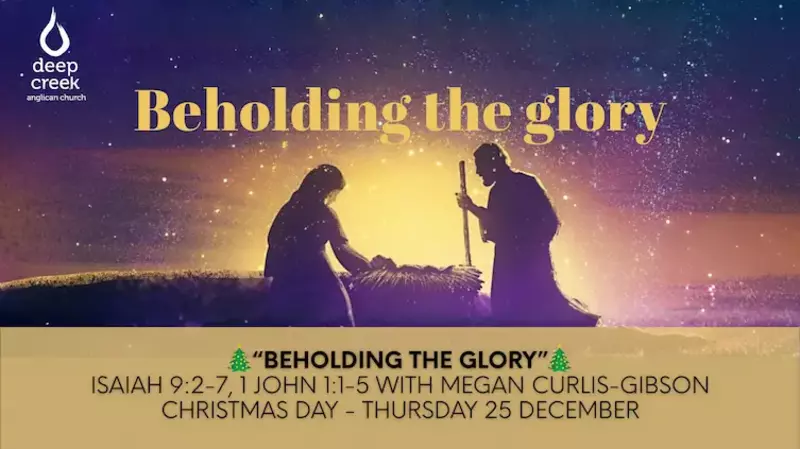
The word became flesh and made his dwelling among us and we are called to behold his glory.
Walking in Darkness
Now, it's nice and bright this morning. We didn't know what the weather was going to be like because it's Christmas in Melbourne. But, of course, the hardest time to see, to behold anything is when you're in the dark.
Earlier this year, my family and I traveled overseas and at one point we crossed the Arctic Circle right up the top. The Arctic Circle is kind of an imaginary line. It shifts a little bit every year because the earth tilts and science things. But what it means is it's the place after which:
- For at least one day per year the sun doesn't set at all.
- And for one day per year, at least, the sun doesn't rise at all.
Now, we were early enough in the year that it didn't really affect the length of our days. But if we were there right now, it would be pitch black. It would not matter whether we were waiting to celebrate Christmas with candles or in the morning. It would be pitch black.
I don't know what those people who have told us all about Santa and the elves are thinking. But for almost six months of the year, the North Pole doesn't have as much light as they might want to make toys, etc. And in fact, this is Svalbard, which is the island closest to the North Pole. And it's been pitch black at 24 hours a day since mid-November. In the North Pole, the sun won't get above the horizon until March.
Now, as you can see here, electric lights make Polar Night a possibility for humans to enjoy, to live in. And they're really valued. On my phone, I follow someone who lives in Svalbard. And recently, they've had some power outages. And so everyone has their generators, their backup batteries. Because living in the dark is hard. Traveling anywhere, walking in the dark, is even harder.
Well, in our reading from Isaiah 9, we get a picture of a whole people group, a whole nation walking in the dark. Now, it is metaphorical darkness. It's poetic. It's spiritual. But it's not nice. It's national trauma.
At the time of writing, God's ancient people were living through invasion, the threat of displacement, political fear, economic collapse, deep spiritual confusion. Where was God? Why was this happening? They were walking in the human darkness that comes from uncertainty, hopelessness and fear.
Many of us know what it's like to walk in that kind of darkness too. Maybe 2025 has had some of that for you:
- Anxiety, loss, exhaustion, uncertainty, grief.
- Worry about those who are not with us, those who are living overseas.
And of course, Australians of all backgrounds are reeling from the tragedy at Bondi. And everyone is longing for something stronger, steadier, brighter than what the world seems to keep offering.
A Light Breaks Through
But into that darkness, God breaks through.
"The people walking in darkness," Isaiah wrote, "have seen a great light. For to us, a child is born. A son is given. And the government, the leadership, the rule, the kingdom will be on his shoulders."
A promise of something to come that would break through the darkness with a light that could not be overcome. And a joy that would not only fill the nation, but enlarge it, bringing people from all around. Something that we love to get a little taste of here at Deep Creek.
Now, there was a little bit of fulfillment in Isaiah's time. Children were born that were the promise of a generation that would be restored to the land after displacement, and that happened. But the promise of a great light, a child who would be called Wonderful Counselor, Mighty God, Everlasting Father, Prince of Peace, well, that was for the future.
And it's John in his gospel that tells us how that promised light turned up. And in whom? Jesus Christ.
"The true light that gives light to everyone was coming into the world," he writes in verse 9.
And in verse 14:
"The word became flesh and dwelt among us, and we have seen his glory."
The solution to the darkness of a fearful and confused humanity was not the gift of enlightenment through a philosophy or a new spirituality, something revealed in a book. No, it was the light himself. The one in whom there is no darkness at all. The son of God, the God who said, let light shine in the darkness at the very beginning of the world. The one through whom all things were made.
And God didn't open a trap door in heaven or pull the curtains apart to show his light, to say, look up here, behold me far away. No, John tells us that the word became flesh and made his dwelling among us.
God moved into the neighborhood as glorious light that could never be extinguished and lit the earth from within. Living as the most glorious human and then drawing all human beings into his joyful family of people of all nations when they trusted in him.
From History to Reality
Now, in the midst of 2025's ups and downs, it's possible that like Isaiah's promise, John's words in chapter one about Jesus could feel distant. Or at best, like spiritual truths that kind of don't have evidence, but maybe they're comforting for a season. Beautiful, incredibly expressed, A++ John.
But it's hard to know maybe how we can behold a baby that was born 2000 years ago. Especially in a world where we're still facing and fighting the darkness.
Well, it's important to remind ourselves that we are exactly the people to whom John was writing. He wasn't actually writing to people who could see the baby in front of them. He wasn't even writing to people who had seen Jesus in the flesh, as it were. He records Jesus' words speaking into this. Thank you, Nick.
When Jesus saw Thomas and he says:
"Because you have seen me, you have believed, but blessed are those who have not seen and yet have believed."
The Jesus who was born at Christmas and died at Easter was not simply accessible to those within that time period to behold him. To grow in faith, to look and keep on looking. No, Jesus knew that he would be the risen one, the living one. So that all people could behold, encounter, experience him in every generation.
He rose again and he can be perceived, beheld, known, encountered today.
Now, the Apostle John, he felt this truth in his bones. He wrote letters to the early church, to early Christians who had not seen Jesus in the flesh, but who needed to know that they could encounter him in the midst of confusion, in the midst of fear, in the midst of opposition and questions and grief and doubt, just like us.
And so he begins his letter, not his gospel, his letter like this.
"That which was from the beginning, which we have heard, which we have seen with our eyes, which we have looked at and our hands have touched. This we proclaim concerning the word of life."
We heard him. We saw him. We looked at him. We touched him. And the encounter that we had with him makes us rock solid, sold out, convinced that he is the light that was promised. But we also encountered him as the risen one who is available to all. And we know that you can encounter him too.
Now, on the same trip that we took earlier this year, we went to Berlin. I'd never been there before, but it's hard not to know something of the history, of course. I did have a photo, but I'm not sure where that's gone because I can see a strange slide coming up next. There we are. Thank you very much.
Yes, I knew the history a little bit. World War I, World War II, the Cold War, the Berlin Wall. But standing in the place where it happened was so different. It was overwhelming. It was overpowering. It was actually quite unpleasant, actually.
- To see the bullet holes in the masonry that they live with day to day.
- To imagine what it would have been like to have armed guards keeping you in one half of a city when the day before you'd been able to travel between the two.
And it moved the history from my head, and I won't say to my heart, but sort of to my guts. I wasn't there when the bullets were flying and when the wall was built, but I am in no doubt of the impact of that and its reality.
Now, in a good way, that's the kind of thing John is trying to communicate. It's possible to have confidence in your guts, he says, that the promise of God to Isaiah has come true. The light has shone in the darkness, and it's not at a distance, it's someone you can meet. We met him, John says, and you can too.
And when you do, you will be adopted into the same fellowship that we were, the most loving, joyful family there could be. Father, Son, and Holy Spirit. One God, but a trinity of love and joy from the beginning of all time.
Rewiring Our Joy
And so of course, he writes, to make our joy complete. If light and life has come into the world in Jesus, then this is the ultimate joy. As we behold him, as we look and keep on looking, that light and life becomes ours because we trust him and we want to receive all that he is. And he joins us into a joyful family. It doesn't matter whether you have a celebration with many, many extended family members today, or if it's just you. You are in a joyful, loving family this Christmas.
Neuroscience tells us, actually, that there is a joy center in the human brain. Apparently it's in the right orbital prefrontal cortex, and I'll take their word for it. It's undeveloped when we're born, and it can keep developing over our whole lives. And what develops it?
Loving relationships. Positive, generous, loving connection. Ideally, when someone who wants to be with you spends time with you. That's how the neurons in that section, this one, this side, yep, how they get strengthened. How the pathways keep being made strong.
- When a parent responds to a baby's needs, or delights in a teenager's company and their music taste.
- When a friend or colleague listens to you with compassion and support.
- When someone special shows you that they're happy that you're there.
And the fascinating thing is, the more developed our joy center is, not more joy we have all the time, but the more resilient we are in the darkness. Yes, we can feel joy, but also we can travel through hard times. We're able to resist the lure of unhelpful addictions. We can weather the storms. The joy center enables us to know that we'll get through it. We are valued, we are seen, we are not alone.
This is the joy that John is pointing to on an unimaginable scale. The God who made the universe, who said, let there be light in whom there is no darkness at all, wanted to be with his people so much. Enjoyed them so much, valued them so much, that he would become a vulnerable baby and a vulnerable man who would be put to death on a Roman cross.
This is the love he has for us, the value he places on us. How much he delights in his created human beings. The word became flesh and dwelt among us and he brings us joy. Not temporary pleasure, not even Christmas cheer, but a joy that is complete because it rests in the God who is faithful, loving and near.
Closing Prayer
So look and keep on looking at Jesus. Read his word, be confident in his truth, open yourself up to his Holy Spirit. Pray to him, even if you haven't done that for a while. And we're going to do that now and I'll invite the band to come up as we do.
Almighty God, thank you for this gathering and for each person here. Thank you for coming to us, not as a distant idea, but as a person, as the word made flesh, bringing light into darkness and joy into weary hearts.
Help us to behold you today, even in the midst of whatever we are doing, to look and keep on looking, to pause, to take in your glory. Shine your light, Lord, into the places we carry in shadow and fill us with the joy that only you can give. A joy that rests in knowing that we are loved, held and never alone.
Amen.